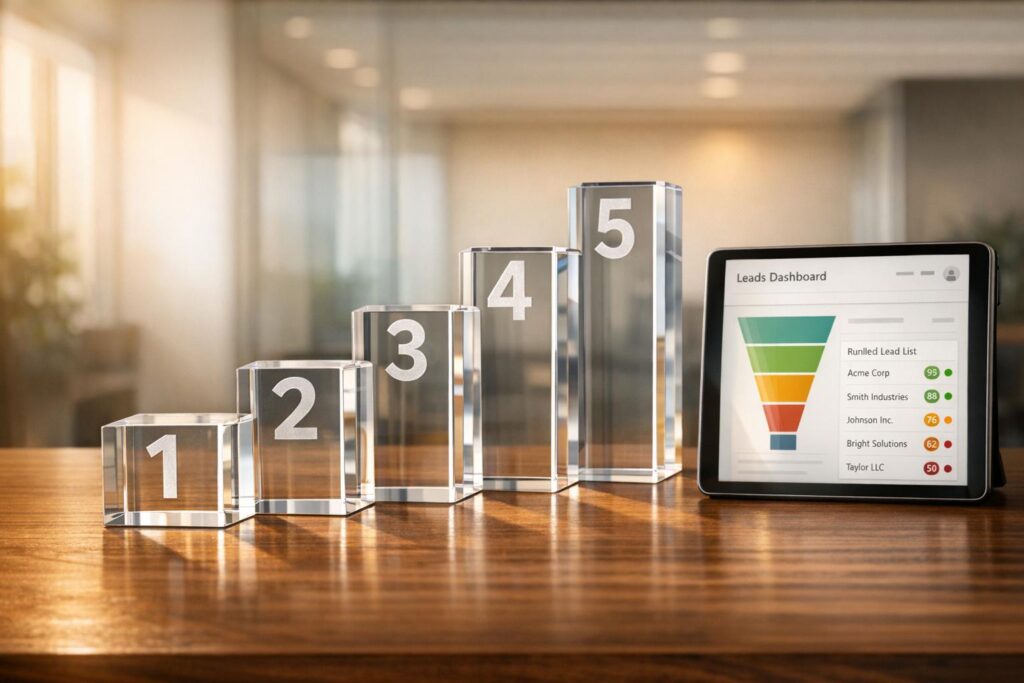
AI lead scoring helps businesses rank potential customers based on their likelihood to convert. Unlike older methods that rely on manual scoring, AI uses machine learning to analyze large amounts of data, such as website activity, CRM records, and third-party information. This makes scoring faster and more precise, helping sales teams focus on high-priority leads.
Key Benefits:
- Higher Accuracy: AI-based lead scoring is more accurate than manual methods.
- Improved Efficiency: Sales teams save time by automating lead qualification.
- Better Results: Companies using AI see higher conversion rates and shorter sales cycles.
How It Works:
- Data Sources: AI pulls from CRM data, behavioral signals (e.g., website visits), and third-party enrichment.
- Real-Time Scoring: Scores update instantly based on new engagement, like visiting a pricing page.
- Custom Models: AI tailors scoring based on your business needs, considering factors like job titles and company size.
Metrics to Track:
- Conversion Rate: Higher with AI.
- Sales Cycle Time: Shorter with AI.
- Qualification Costs: Lower with AI.
Platforms like CRMCoPilot connect with tools like Salesforce and HubSpot and rank prospects by fit against your own products and services, so your team can start with the leads most likely to be a good match.
Benefits of AI Lead Scoring
Better Accuracy in Lead Scoring
AI takes the guesswork out of lead scoring by analyzing hundreds of data points – far beyond the handful of factors humans typically consider [3]. Instead of relying on subjective judgment or manual weighting, AI uncovers patterns in historical deal data, avoiding mistakes caused by fatigue or emotional bias [1][12].
The results speak for themselves: AI-driven lead scoring achieves 80%–90% accuracy, compared to the 30%–40% range seen with traditional methods [12]. For example, Salesforce users reported a 32% boost in converting prospects to customers after adopting AI for lead scoring [12]. This improvement happens because AI recognizes subtle differences, like understanding that a VP at a startup has different conversion potential than one at a Fortune 500 company – something static scoring systems often miss.
What sets AI apart is its ability to learn and adapt. As market trends and buyer behaviors change, AI models evolve, ensuring scores remain relevant [10][1]. Updates happen in real time, so if a prospect visits a pricing page, the system adjusts their score immediately [10][3]. This dynamic approach not only improves lead quality but also lightens the load for sales teams.
Time Savings for Sales Teams
AI dramatically reduces the time sales teams spend qualifying leads. Instead of manually researching demographics, company details, or online behavior, AI handles these tasks automatically [14][2]. Default’s proprietary study of over 88K inbound leads found that AI-powered features reduce the time it takes to service an inbound lead by 31% [4].
On average, AI reduces the time sales reps spend on initial lead qualification by 30%–40%, slashing qualification costs by 60%–80% [5]. AI works around the clock, meaning leads that come in after hours are scored and enriched by the time sales reps start their day [4][5]. This efficiency can shorten sales cycles, enabling companies to focus on ready-to-buy prospects while nurturing others over time. monday.com, citing McKinsey research, says companies that use AI in sales can increase leads and appointments by more than 50% [5][3].
Better Sales and Marketing Alignment
AI doesn’t just improve accuracy and save time – it also bridges the gap between sales and marketing teams. By creating a shared, data-driven definition of what qualifies as a "hot lead", AI eliminates disagreements over lead quality [12][3]. This transparency builds trust, as sales teams are more likely to act on leads scored using clear, historical data rather than arbitrary systems [6].
In Salesforce’s State of Sales report, 98% of sales leaders say they believe AI will improve lead prioritization, resulting in greater efficiency and revenue [12].
AI applies consistent rules to all leads, regardless of their source, reducing errors and streamlining the handoff from marketing to sales [3]. This consistency is crucial – monday.com, citing Harvard Business Review, says companies that respond to leads within an hour are seven times more likely to have meaningful conversations with decision-makers than those that respond even an hour later [3]. Together, these benefits help businesses refine their lead management process and drive stronger revenue outcomes.
The SIMPLEST Way To Build An AI Lead Scoring Assistant (AI Automation)
Data Sources for AI Lead Scoring
AI lead scoring relies on three key data types to predict lead conversion: CRM data, behavioral signals, and third-party enrichment. Together, these sources provide a comprehensive view that helps rank leads effectively. Let’s break down how each one contributes to the process.
CRM Data
Your CRM serves as the backbone for AI lead scoring models [3][6]. It houses historical data like contact records, deal stages, communication logs, lifecycle transitions, and outcomes – essential elements for machine learning algorithms to identify high-potential leads [3][6][11]. With this information, AI can rank leads in real time based on their likelihood to convert [3][6]. However, the quality of your CRM data is critical. If the data is messy or incomplete, the results will reflect that – essentially a "garbage in, garbage out" scenario [2][3].
Behavioral and Engagement Data
Behavioral data offers a dynamic perspective on buyer intent, capturing signals that static demographics can’t [3]. AI tracks actions like website visits (e.g., page views, pricing page visits), email engagement (opens, clicks), content downloads, and event participation to gauge interest in real time [3]. Instead of assigning fixed points to these actions, AI evaluates how they interact – considering factors like visit frequency, the sequence of downloads, and the depth of engagement [6].
As an illustrative example of the patterns AI can find, monday.com describes prospects who visit a pricing page on mobile between 7:00 PM and 9:00 PM being twice as likely to convert [3]. Advanced AI models can even analyze the tone and sentiment of email replies or call transcripts to distinguish between casual inquiries and serious interest [3]. This type of "implicit" scoring often proves more accurate than self-reported data because it reflects observed behaviors rather than stated intentions [8].
While behavioral data captures immediate intent, it’s third-party data that fills in the gaps to create a complete picture of each lead.
Third-Party and Enriched Data
When internal CRM data falls short, third-party enrichment steps in to complete lead profiles [2][3]. This data includes firmographics (e.g., company size, industry, revenue, funding), demographics (e.g., job titles, LinkedIn profiles), and technographics (e.g., current tech stack). These details help AI separate casual browsers from serious buyers.
Platforms often query multiple external data providers to ensure accuracy and detail. Automated systems keep records up-to-date by pulling real-time updates from licensed data partners, eliminating the need for manual uploads. This continuous enrichment allows AI models to adapt quickly to new signals, such as recent funding rounds or the adoption of new technologies, ensuring that lead scores remain current and relevant.
How to Implement AI Lead Scoring
Once you’ve secured high-quality data, the next step is putting AI lead scoring into action. Here’s how to do it effectively.
Step 1: Review Your Current Lead Management Process
Before diving into AI, take a step back and assess your current setup. Look at your monthly lead volume, conversion rates, and response times. For instance, how quickly do you respond to leads? This is critical: monday.com, citing Harvard Business Review, says responding within an hour makes you seven times more likely to have meaningful conversations with decision-makers than responding even an hour later [3].
Also, evaluate the quality of your CRM data. With 76% of businesses believing that poor data quality and analytics hurt revenue opportunities, according to Salesforce citing AIMultiple [12], chances are your data might need some cleanup before introducing AI. This initial analysis provides the foundation for fine-tuning your lead scoring approach.
Step 2: Define Your Ideal Customer Profile
To guide your AI model, you need to define what a "perfect lead" looks like. Start by analyzing your top-performing customers from the past 12–24 months. Look for patterns – what roles do they hold? What company sizes convert most often? Do actions like attending webinars or frequent visits to your pricing page signal higher intent?
Stick to a short list of key attributes that your sales team already values. Don’t forget to include negative indicators too, like deducting points for personal email addresses or visits limited to your careers page [8]. This ensures the AI can identify both strong and weak leads right from the start.
Step 3: Prepare and Integrate Your Data
Next, gather data from all relevant sources: your CRM, marketing automation tools, website analytics, and any third-party enrichment platforms. Clean up this data by removing duplicates, standardizing formats, and filling in missing fields [2][3][12].
Integrate these systems using real-time APIs so lead scores update instantly as prospects interact with your brand [18]. Also, implement data retention policies to delete outdated information, ensuring compliance with regulations like GDPR or CCPA [18]. Once your data is polished and connected, you’re ready to train your AI.
Step 4: Train and Test Your AI Model
This is where machine learning begins. Provide your AI with historical data from both successful and unsuccessful deals to help it recognize patterns that predict conversions [2][10][12]. Oracle’s AI Lead Score, for example, requires at least 1,000 closed leads, including 100 converted ones, as a bare minimum, and Oracle warns that small numbers may not produce meaningful predictions [10].
Split your data into training and testing sets to evaluate the model’s accuracy before launching it [15]. Set initial scoring thresholds, such as sending leads with scores above 85 directly to sales, while nurturing those in the 50–70 range [1][15][3]. This helps build confidence in your AI system.
Step 5: Monitor and Optimize Performance
AI lead scoring requires ongoing attention. Retrain your model monthly or quarterly to keep up with shifting buyer behaviors and market trends [18][3]. Monitor metrics like conversion rates, sales velocity, and revenue per lead to measure its effectiveness. Use these insights to refine your sales and marketing strategies.
Companies that regularly update their models report a 17% increase in lead conversion rates [18]. Establish a feedback loop with your sales and marketing teams through quarterly reviews to tweak scoring weights and criteria based on recent successes [8]. Consistently audit your data, test different scoring approaches, and account for seasonal trends [18][1]. Keeping your model fresh ensures it stays effective over time.
sbb-itb-0ae5139
Metrics for Measuring AI Lead Scoring Success
Tracking the right metrics is essential to understand how well your AI-powered lead scoring system performs. These measurements help confirm the benefits and ensure the system positively impacts your business. Let’s break it down into three key areas that directly influence your results.
Conversion Rate Improvements
One of the clearest indicators of success is your lead-to-customer conversion rate. Calculate it using this formula:
(Converted Leads / Total Leads) x 100 [8].
Before rolling out AI, establish a baseline conversion rate to measure any changes. Keep an eye on conversion rates across different score ranges – leads with the highest scores should convert at a higher rate.
On average, companies using AI for lead scoring report 20% to 30% higher conversion rates [5]. To gauge your specific improvement, use this formula:
[(Conversion rate of AI-prioritized leads – Conversion rate of baseline leads) / Conversion rate of baseline leads] x 100 [2].
Additionally, track precision (how many high-scoring leads actually convert) and recall (how many total conversions the AI correctly identifies). These metrics ensure the model isn’t overlooking potential opportunities [2]. As conversions rise, you’ll likely see improvements in deal velocity and overall revenue efficiency.
Sales Cycle Reduction
AI lead scoring doesn’t just improve conversions – it also speeds up the sales process. By focusing your team on leads ready to buy, deals close faster. To measure this, track metrics like sales velocity and lead response time, as quicker responses often lead to faster deal closures [3][5].
For example, monday.com, citing Harvard Business Review, says responding within an hour makes meaningful conversations with decision-makers seven times more likely [3]. Companies using AI scoring typically report 20% to 40% shorter sales cycles [5].
AI also allows sales reps to focus their time more effectively. Teams often report spending up to 80% of their efforts on qualified leads, compared to just 30% when using manual methods [3]. This shift in focus naturally accelerates the sales process.
Revenue Per Lead
AI scoring doesn’t just improve efficiency – it can also boost your revenue. Start by calculating the average revenue per lead across different score tiers. Higher scores often align with larger deal sizes [3].
Businesses using AI scoring have reported 10% to 20% revenue growth within the first year [5]. Another key metric is lead qualification cost, which measures the expense of moving a lead to the SQL stage. AI can reduce these costs by 60% to 80% by automating manual tasks [5].
Finally, track your marketing ROI. AI often improves ROI by 35% as it reallocates budgets toward channels that generate higher revenue [5].
| Metric | What It Measures | Expected Impact with AI |
|---|---|---|
| Conversion Rate | % of leads becoming customers | 20-30% increase [5] |
| Sales Cycle Time | Days from lead capture to close | 20-40% reduction [5] |
| Qualification Cost | Cost to move lead to SQL stage | 60-80% reduction [5] |
| Sales Productivity | Time spent on qualified prospects | Increase from 30% to 80% [3] |
| Marketing ROI | Revenue per marketing dollar | 35% improvement [5] |
How CRMCoPilot Supports AI Lead Scoring
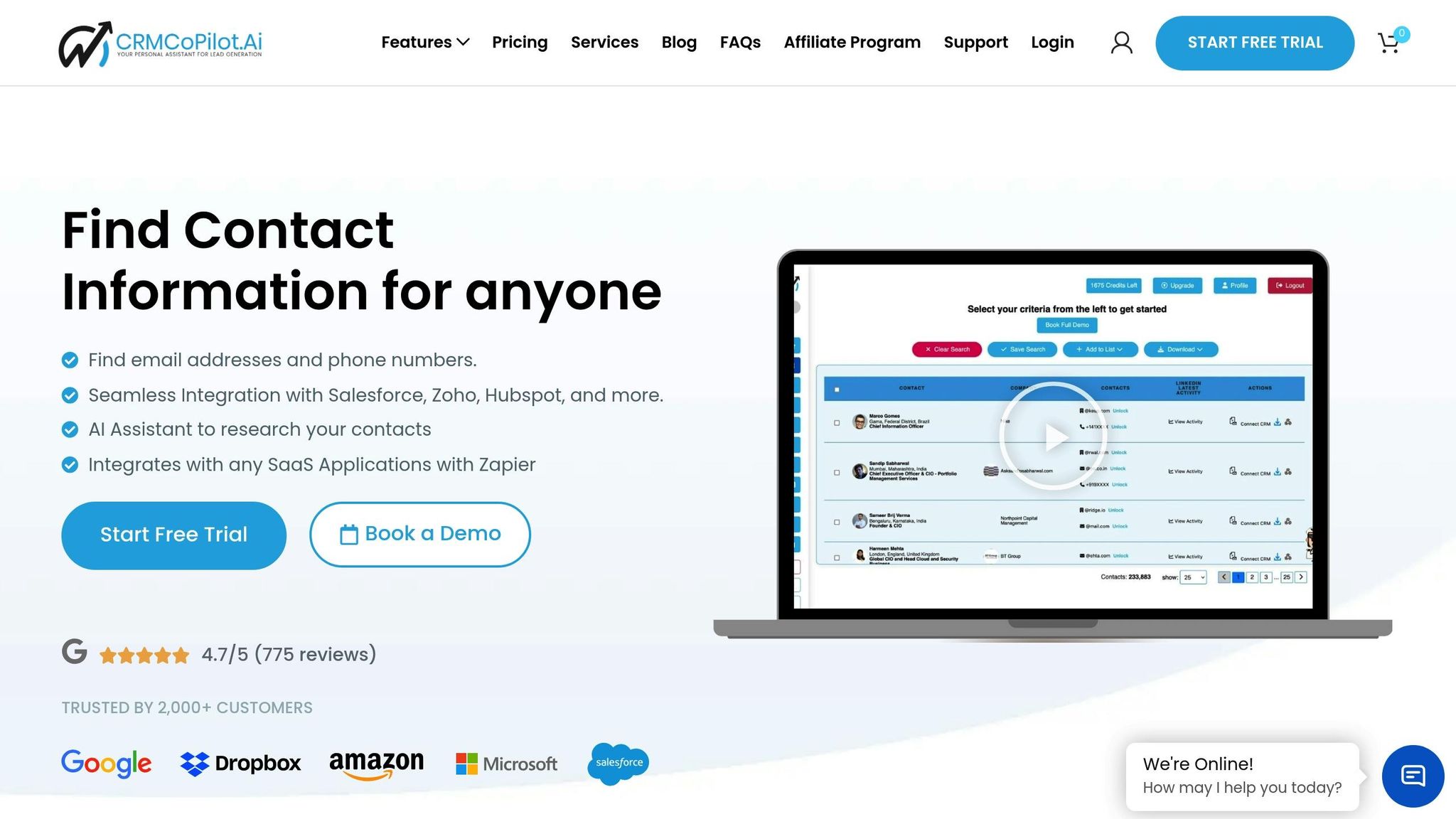
CRMCoPilot does not replace a predictive scoring model inside your CRM. It scores prospects before they get there, by fit against your own products and services, and helps your team decide who to contact each day.
Verified Contact Data
Emails are checked for deliverability before a lead reaches your CRM, so your scoring model isn’t working from addresses that bounce. Work emails and phone numbers are unlocked only when found.
Integration with Popular CRMs
CRMCoPilot integrates natively with GoHighLevel, Zoho CRM, Pipedrive, HubSpot and Salesforce, and you connect one from Settings → Integrations.
You choose the destination CRM per search or Autopilot agent, and CRMCoPilot checks for existing records by email and company domain before exporting. On Gold and Platinum, CRM Focus puts daily ranked actions and live site visitors inside your CRM (Zoho today).
Automated Lead Prioritization
AI scoring tools update priorities as new engagement signals – like a pricing page visit or webinar attendance – come in [3]. Timing matters: SalesWings, citing InsideSales.com, says reps who respond within 5 minutes get 900% more conversions than those who wait 10 [21].
CRMCoPilot’s Today page gives each rep a ranked list of who to contact and why, and AI agents such as Engagement Radar (and, on paid plans, Hiring Signal and Account Watch) flag buying signals as they appear. Autopilot can deliver a set number of new leads per day, assigned to a fixed owner or round-robin.
Conclusion
AI-powered lead scoring is transforming how businesses prioritize leads, driving impressive results like a 20–30% increase in conversion rates and up to a 40% reduction in sales cycles [5]. By learning from every win and loss, this technology adjusts its scoring criteria automatically, staying aligned with evolving market conditions.
Sales teams leveraging AI spend as much as 80% of their time engaging with qualified leads, a significant jump from the 30% achieved through manual methods [3]. This boost in efficiency comes from the ability to instantly prioritize and route high-scoring leads to sales reps. Quick response times matter – SalesWings, citing InsideSales.com, says reps who respond within 5 minutes get 900% more conversions than those who wait 10 [21].
Platforms like CRMCoPilot support this process by checking emails before leads reach your CRM, ranking prospects by fit, and giving reps a daily ranked list of who to contact. These tools make it easier for businesses to move away from manual lead management.
For high-performing teams, AI-driven lead scoring has become a standard practice. Companies using this approach often see a 35% boost in marketing ROI [5]. With clean data and the right platform, any organization can tap into these benefits, improving conversion rates, sales efficiency, and overall revenue growth.
FAQs
How does AI-powered lead scoring help boost conversion rates?
AI-powered lead scoring takes conversion rates to the next level by leveraging advanced data analytics and machine learning. Unlike old-school methods that often depend on guesswork or outdated criteria, this modern approach evaluates leads using real-time data and predictive models.
The result? Sales teams can zero in on leads with the best potential, saving time and boosting productivity. Businesses that use AI for lead scoring often see higher conversion rates compared to traditional methods. It’s a game-changer for prioritizing high-quality leads and driving better outcomes.
What key data points are essential for accurate AI lead scoring?
AI lead scoring analyzes important data points to predict which leads are most likely to convert into customers. Here’s a breakdown of the key data it examines:
- Web activity: Tracks actions like site visits, clicks, and time spent browsing your pages.
- Email engagement: Looks at metrics such as email opens, link clicks, and replies.
- CRM updates: Reviews details like lead status, notes, and past interactions logged in your CRM system.
- Demographic and firmographic data: Considers factors like a lead’s industry, company size, and job role.
- Behavioral patterns: Spots trends in how leads engage with your brand across various touchpoints.
With these insights, AI tools can rank and prioritize leads, helping your sales team zero in on those with the highest potential. This means less time chasing cold leads and more time closing deals.
How can businesses keep their AI lead scoring models accurate over time?
To keep AI lead scoring models accurate, businesses need to retrain models regularly with up-to-date data. This includes incorporating recent customer interactions, behavior changes, and shifts in market trends. Doing so ensures the model stays aligned with current patterns and remains effective.
Equally important is monitoring the model’s performance. By tracking key metrics, businesses can spot any drop in accuracy early. Making adjustments based on these insights helps maintain the model’s reliability and ensures it continues to meet business objectives.
Put your reps on the best-fit prospects
CRMCoPilot ranks prospects by fit against what you sell and checks emails for deliverability before leads reach your CRM.