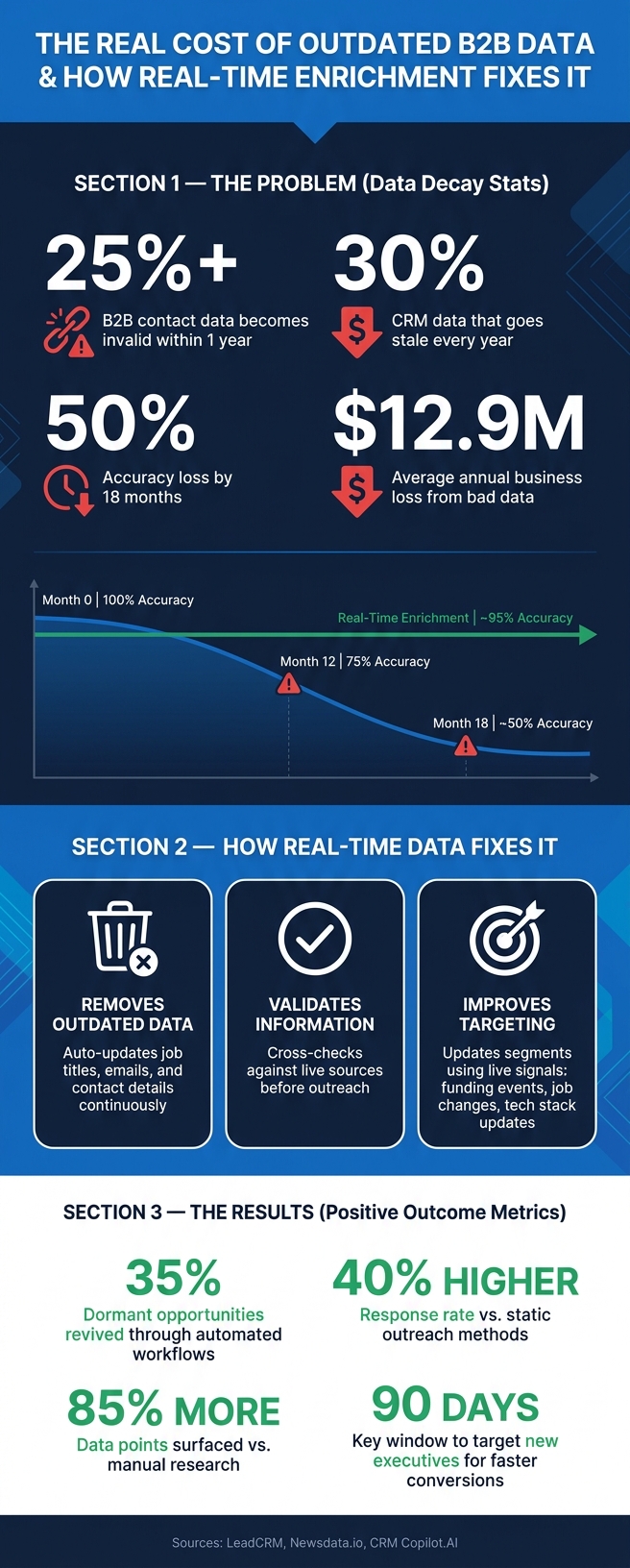
Outdated data is costing you time and money. Over 25% of B2B contact data becomes invalid in a year, and by 18 months, accuracy can drop to 50%. This means half of your leads may no longer be relevant, leading to wasted outreach efforts, damaged email reputations, and $12.9 million in yearly losses for businesses.
Real-time data solves this problem by keeping your CRM updated with live information. It ensures your team works with accurate, actionable data, boosting lead quality and improving results. Here’s how it helps:
- Removes outdated data: Automatically updates contact details like job titles and email addresses.
- Validates information: Cross-checks against live sources to catch errors before they affect outreach.
- Improves targeting: Updates audience segments in real-time based on live signals like funding events or job changes.
Switching to real-time data eliminates inefficiencies, prioritizes high-quality leads, and increases sales conversions by focusing on timely opportunities. Tools like CRM Copilot.AI integrate seamlessly with platforms like Salesforce and HubSpot, automating workflows and keeping your pipeline accurate.
Outdated data is a liability. Real-time data ensures your team connects with the right leads, at the right time, with the right information.
The Real Cost of Outdated B2B Data & How Real-Time Enrichment Fixes It
The System That Fixes Your CRM Data in Real Time (Without Breaking It)
sbb-itb-0ae5139
How Real-Time Data Improves Lead Accuracy
Real-time data doesn’t just make things faster – it transforms the way leads are handled, ensuring they’re accurate from the moment they enter your pipeline. This approach allows sales teams to work with reliable, actionable information.
Getting Rid of Outdated Lead Data
Traditional lead management often collects data once and lets it sit, which can quickly lead to inaccuracies. In fact, around 30% of B2B CRM data becomes outdated each year as people switch jobs, companies rebrand, or contact details change [2]. Real-time systems tackle this issue by re-verifying records whenever a sales rep interacts with them, keeping the information fresh and accurate.
Real-time enrichment identifies changes before sales reps waste time on outdated or incorrect outreach.
"Your messaging can be sharp. Your ICP can be defined. But if the contact data is six months old, none of that matters. You’re sending the right message to the wrong version of reality." – Raghav Sharma, Newsdata.io [1]
This continuous cleanup ensures that your data remains dependable over time.
Ongoing Data Verification and Validation
Once outdated records are removed, real-time systems take it further by continuously verifying data. Instead of relying on occasional updates, these systems validate critical details – like email addresses, phone numbers, and job titles – right at the moment of record creation or outreach. This proactive approach prevents errors from slipping through.
Modern platforms cross-check data against multiple live sources, flagging and resolving discrepancies – such as mismatched job titles – using the most up-to-date information available. This method, often referred to as waterfall enrichment, minimizes the risk of acting on outdated or incorrect data [2].
"Real-time enrichment turns your CRM into a reliable source of truth, cutting out manual fixes and enabling your team to act with confidence, not caution." – LeadCRM [2]
Tools like CRM Copilot.AI bring this concept to life by using AI-verified contact data and real-time checks to ensure accuracy before a sales rep even begins outreach.
Better Audience Segmentation and Targeting
Verified, up-to-date data takes audience segmentation to the next level. Accurate information ensures you’re reaching the right person at the right time. Real-time enrichment automatically updates audience segments based on live signals like recent funding events, hiring trends, or changes in a company’s tech stack [2].
Combining fit signals (such as industry, company size, and revenue) with intent signals (like visiting a pricing page or submitting a demo request) sharpens your targeting. Using just one type of signal can lead to false positives. For instance, a VP title at a 5-person startup with no budget isn’t the same as a VP title at a 300-person SaaS company that aligns with your ICP [3]. Real-time data paints a complete picture, helping your team focus on opportunities that truly matter.
Key Benefits of Real-Time Data for Sales Teams
Real-time data doesn’t just keep your records accurate – it can transform how sales teams operate, driving efficiency and better results.
Faster Lead Qualification
When a new lead enters your pipeline, timing is critical. Real-time data enrichment steps in immediately, verifying details like lead activity, job role, and seniority. This allows sales reps to tailor their outreach right away. With routing and scoring handled in seconds, high-quality leads get prioritized without delay.
Automated triggers make this process even sharper. For instance, if a company announces a fresh funding round, hires a new executive, or updates its technology stack, real-time systems flag that account as high-priority. Acting on such live signals can make all the difference between securing a meeting or losing the opportunity entirely.
Less Time Wasted on Bad Leads
Bad data is a budget killer [2]. A large chunk of wasted resources comes from chasing leads who’ve moved roles, left their companies, or no longer fit your Ideal Customer Profile. Timing is especially crucial with new executives – they’re more likely to switch vendors early in their tenure [1]. Real-time systems tackle this issue head-on, automatically disqualifying leads that don’t match your criteria as soon as they hit your CRM. This eliminates the need for manual cleanup and ensures reps aren’t wasting time on outdated or irrelevant contacts. The result? More time spent on leads that actually convert.
Higher Sales Conversion Rates
When you combine faster lead qualification with reduced effort on bad leads, your team can focus on what matters: engaging the right prospects at the right time. For example, targeting decision-makers during their active buying windows – like the first 90 days of a new executive’s tenure – can significantly accelerate the sales process.
On the flip side, relying on outdated data can be costly. Data that’s 18 months old may degrade by 40–50% [1], meaning nearly half your outreach could be ineffective. Real-time verification tools, like those offered by CRM Copilot.AI, use AI-verified contact data and automated workflows to combat data decay. This ensures your team’s efforts are focused on leads with the best chances of converting, protecting your conversion rates from slipping away unnoticed.
Real-Time Data in Practice
Understanding that real-time data improves lead quality is one thing – seeing it in action within your sales tools is where the real magic happens. The key lies in how well real-time data integrates with your CRM and daily workflows. Let’s break down how these integrations work in practice.
Connecting Real-Time Data to CRM Systems
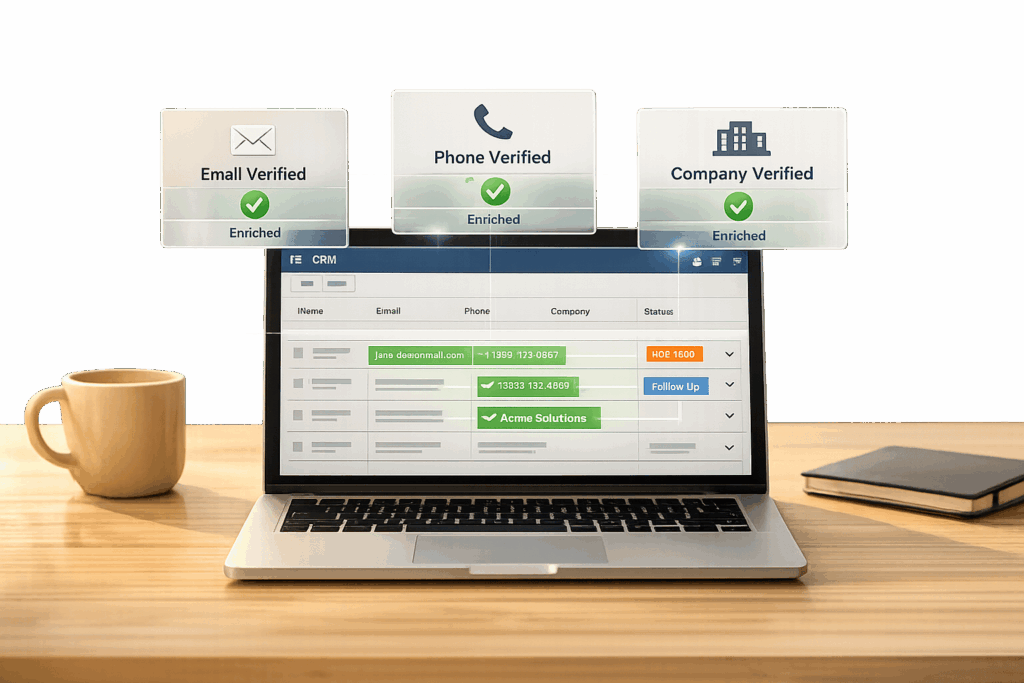
The easiest way to start is with a native CRM integration. Tools like CRM Copilot.AI directly connect with platforms like Salesforce, HubSpot, and Zoho, ensuring live data enrichment flows seamlessly into your existing setup. No more manual data entry! Whenever a contact’s details change – whether it’s a new job title or a company’s funding announcement – your CRM updates instantly.
This two-way sync is a game-changer. It eliminates delays between real-world changes and when your team learns about them. Plus, every prospect interaction – like meeting bookings, email replies, or LinkedIn activity – is automatically logged into the system [4].
Automating Workflows with Real-Time Data
Once your CRM is enriched with live data, automation takes the process to the next level. Imagine this: your system detects that a key contact at a target account has switched roles. Instantly, the account gets flagged as high-priority, and a personalized outreach sequence is triggered – all without any manual effort.
Automation also shines when it comes to re-engaging dormant leads. Instead of letting inactive prospects gather dust, automated workflows can identify inactivity and launch tailored follow-up campaigns. According to platform insights, these workflows can revive 35% of dormant opportunities [4]. Combine that with real-time lead scoring that updates dynamically as prospects engage, and your pipeline stays fresh and active.
Multi-Channel Outreach Driven by Real-Time Data
Real-time data doesn’t just enhance CRM workflows and automation – it also powers more impactful multi-channel outreach. With up-to-date contact information, your emails and LinkedIn messages can reflect a prospect’s current role, company milestones, or recent news. This level of personalization hits harder than outdated, generic messaging. In fact, real-time enrichment can surface 85% more data points compared to manual research [4], giving your team the insights they need to craft meaningful, timely outreach.
Live signals also improve cross-channel coordination. For example, if a prospect responds on LinkedIn, an automated "smart pause" can temporarily halt an email sequence, preventing your communication from feeling robotic. This approach delivers a 40% higher response rate compared to static outreach methods [4].
Conclusion: Making the Most of Real-Time Data
Static data is more than just an inconvenience – it’s a costly liability. With up to 30% of B2B CRM data becoming outdated every year [2], organizations face an average loss of $12.9 million annually [2]. That’s a staggering price to pay for inaction. Relying on static data not only drains resources but also undermines the effectiveness of your sales and marketing efforts.
Switching to real-time enrichment offers a way out of this costly trap. By replacing outdated batch updates with live data, teams can operate more efficiently. Sales reps can avoid wasting time on outdated leads, while workflows can be triggered automatically by meaningful, real-time signals. This ensures outreach happens at the right moment, giving your business a competitive advantage.
"The most competitive businesses will treat real-time enrichment as the intelligent core of their revenue strategy, blending live updates, predictive AI, and human oversight." – LeadCRM [2]
To get started, begin with a CRM audit. Look for incomplete fields, duplicates, and other inconsistencies – this ensures you’re not building processes on flawed data. Once your CRM is cleaned up, test real-time enrichment with a high-priority segment, such as demo requests or inbound LinkedIn leads. This step-by-step approach makes it easier to scale the benefits across your entire pipeline.
Tools like CRM Copilot.AI simplify this process by combining real-time data verification, AI-powered lead scoring, and automated workflows into one seamless system. By syncing your CRM, you’ll create a live, accurate source of truth that empowers your sales team to make confident, data-driven decisions. Real-time enrichment isn’t just a tool – it’s a game-changer for transforming your sales pipeline into a proactive, results-driven machine.
FAQs
What counts as real-time data in a CRM?
Real-time data in a CRM refers to information that’s collected, verified, and updated instantly as it unfolds. This could mean validating contact details like email addresses or phone numbers right away, adjusting lead scores dynamically based on user engagement, or receiving live updates about job changes or company events. Tools such as CRM Copilot.AI help ensure this data remains accurate and effortlessly integrated, providing sharper sales insights.
How does real-time verification reduce bounced emails and bad leads?
Real-time verification helps reduce bounced emails and bad leads by checking contact details as they’re entered. It ensures email addresses and phone numbers are active and valid by using multiple layers of verification. This process prevents outdated or incorrect data from cluttering your CRM, safeguarding your sender reputation and ensuring your messages reach the right audience. Tools such as CRM Copilot.AI handle this automatically, allowing sales teams to concentrate on leads that are accurate and ready for action.
Which live signals should I use to improve lead targeting?
To improve lead targeting, pay attention to three key types of signals:
- Fit signals: These include details like firmographics (company size, industry) and technographics (the technologies a company uses).
- Intent signals: These are actions that show interest, such as visiting your pricing page or requesting a demo.
- Friction signals: These highlight potential challenges, like complex contracts or budget limitations.
Using tools like CRM Copilot.AI can help you monitor real-time triggers, such as when a prospect changes jobs or their company secures funding. By filtering these signals through your ideal customer profile (ICP), you can ensure your outreach is both timely and relevant.