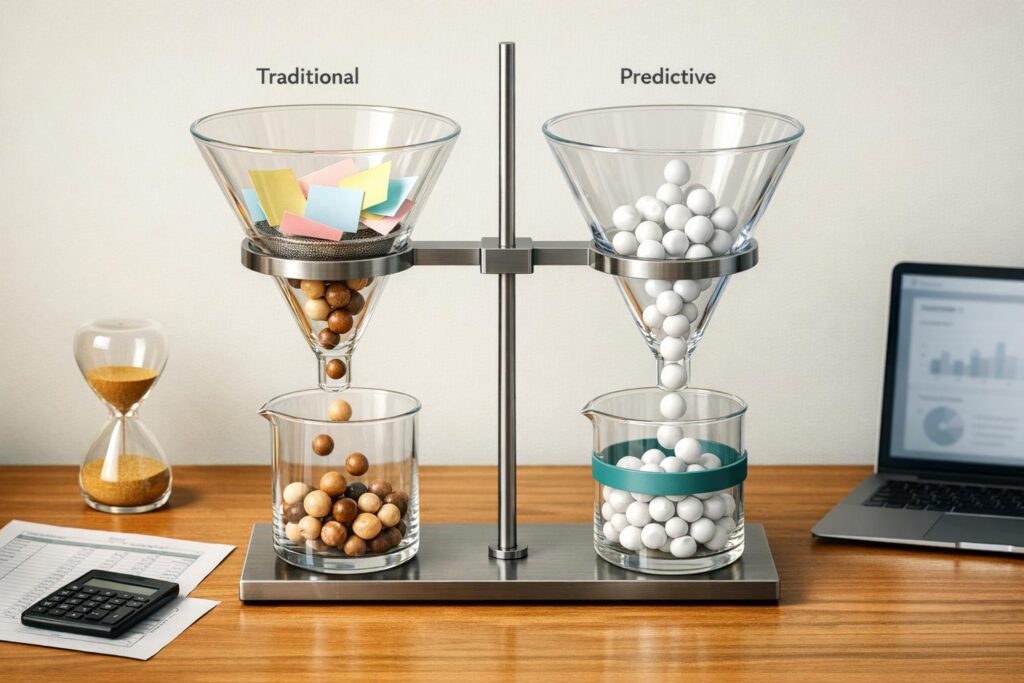
Lead scoring helps sales teams prioritize leads, but not all methods are equally effective. Traditional lead scoring relies on fixed rules (e.g., "+10 points for a C-level title") and evaluates 5–15 attributes. It’s simple but struggles with scalability and accuracy, often requiring manual updates. On the other hand, predictive lead scoring uses AI to analyze hundreds of signals, like behavioral patterns and intent data, delivering a more precise and scalable solution.
Key Takeaways:
- Traditional Scoring: Quick to set up, works for smaller teams, but limited in scope and efficiency.
- Predictive Scoring: Handles large datasets, improves conversion rates by 20–40%, but requires more historical data and setup time.
Quick Comparison:
| Feature | Traditional Scoring | Predictive Scoring |
|---|---|---|
| Data Used | 5–15 attributes | Hundreds/thousands |
| Setup Time | Days to weeks | 3–6 months |
| Scalability | Struggles above 5,000 leads/month | Handles millions of leads |
| Accuracy Improvement | 15–25% | 20–40% |
| Maintenance | Manual updates needed | Automated feedback loops |
Choose traditional scoring if you have fewer leads and limited data. Opt for predictive scoring to scale and boost accuracy with AI-driven insights.
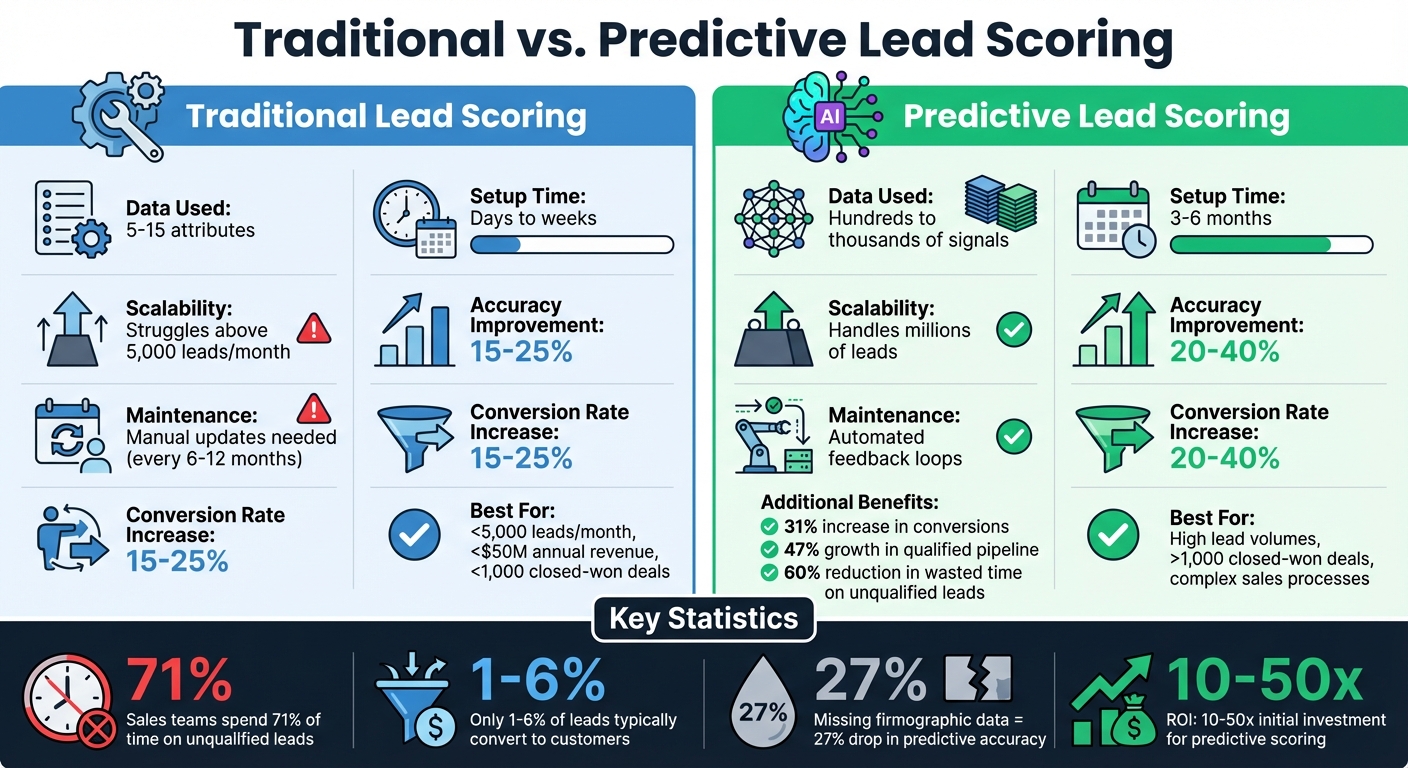
Traditional vs Predictive Lead Scoring: Key Differences and Performance Metrics
The SIMPLEST Way To Build An AI Lead Scoring Assistant (AI Automation)
sbb-itb-0ae5139
What Is Traditional Lead Scoring?
Traditional lead scoring is a manual system where fixed points are assigned to leads based on specific attributes and actions. For example, a lead might earn +20 points for having a C-level title, +10 for visiting a pricing page, or +5 for opening an email. Once a lead reaches a predetermined score – say, 50 or 100 points – it’s marked as ready for the sales team.
This approach relies heavily on human judgment. Marketers manually determine the value of various demographic, firmographic, and behavioral factors. Negative scoring is also part of the process, deducting points for inactivity or signs of competitor engagement. The most common model uses a points-based system, where each action or characteristic is assigned a fixed value. Other variations include scorecards with mathematical weightings or simple filtering models to highlight high-quality leads while filtering out mismatches. However, these systems are static and don’t update automatically, requiring regular manual adjustments to stay relevant.
How Traditional Lead Scoring Works
The process starts with defining an Ideal Customer Profile (ICP) using historical data. Based on this profile, a scoring framework is created to assign points for key attributes and actions. As leads interact with your brand, their scores increase. Once they cross the sales-ready threshold, they’re handed off to the sales team. Some companies also use "nurture tiers" to keep leads engaged through targeted marketing until they show stronger buying signals.
To ensure accuracy, companies often test their scoring criteria against CRM data from past successful ("won") and unsuccessful ("lost") deals. Feedback loops between sales and marketing help fine-tune the scoring system so it better reflects actual outcomes.
While this method offers a structured framework, it comes with several drawbacks that can limit its usefulness.
Limitations of Traditional Lead Scoring
The biggest issue with traditional lead scoring is its reliance on subjective, static rules. These rules are based on assumptions that may reflect the biases of the marketers who create them, rather than being grounded in data. Ben Rose, Growth Marketing Manager at Faraday, captures this well:
"Traditional lead scoring is great – if it’s 2008. But in 2025, teams are managing thousands of signals across channels, and the limitations of hand-crafted scoring systems are showing." [2]
Another limitation is the narrow scope of data used. Traditional systems often focus on basic firmographics and a handful of explicit actions, like email opens. They don’t account for more complex engagement patterns, such as the frequency or intensity of interactions, and they treat all actions – like a single page visit versus multiple visits – equally. This lack of nuance can lead to missed opportunities.
Scalability is another challenge. Adjusting rules for different product lines, regions, or campaigns becomes increasingly time-consuming as organizations grow. This inefficiency contributes to a staggering statistic: sales teams spend about 71% of their time on unqualified leads [5], and in many cases, only 1% to 6% of leads actually convert into customers [3].
These challenges highlight the need for more flexible and data-driven approaches, setting the stage for predictive lead scoring.
What Is Predictive Lead Scoring?
Predictive lead scoring is a method powered by AI that shifts away from manual scoring systems. Instead of assigning arbitrary points to leads, it uses machine learning models trained on historical data – both successful and unsuccessful deals. These models, such as Gradient Boosting, Random Forest, or Neural Networks, analyze thousands of data points to predict the likelihood of a lead converting. The result isn’t a random score like "75 points" but a clear probability, such as an 87% chance of conversion. As Tom Morgan from Revenue Intelligence puts it:
"The interaction of title + company stage + content sequence is structurally invisible to rule-based systems."
One standout feature of predictive lead scoring is its ability to learn continuously. Every closed deal, whether won or lost, feeds back into the system, allowing it to adapt to changing market trends and buyer behaviors. Over time, this feedback loop can improve accuracy by 20–40% within 12–18 months [1]. This constant refinement makes predictive lead scoring a powerful tool for modern sales teams.
How Predictive Lead Scoring Works
Predictive models dive deep, analyzing hundreds or even thousands of signals at once – far surpassing the limited 5–15 attributes used in traditional scoring methods [1]. These signals typically fall into four categories:
- Demographic and firmographic data: Details like job title, company size, or technology stack.
- Behavioral patterns: Actions such as time spent on a page, email engagement, or content downloads.
- Historical CRM data: Past deal outcomes, sales activity, and other internal records.
- Third-party intent signals: External behaviors like off-site research or social media activity.
What sets predictive systems apart is their ability to analyze relationships between actions, not just individual data points. Modern tools also focus on Explainable AI, which helps sales reps understand why a lead received a specific score. This transparency is essential for adoption. As Tom Morgan explains:
"A 70% accurate model that every rep acts on outperforms a 90% accurate model that gets ignored." [1]
By combining precision with clarity, predictive lead scoring gives sales teams the insights they need to act confidently.
Benefits of Predictive Lead Scoring
The biggest advantage of predictive lead scoring is better accuracy. Companies using these models often see conversion rates improve by 20–40%, and some report a 47% increase in qualified pipeline after implementation [1][5]. These results come from the system’s ability to detect buying signals that traditional methods might miss.
Another benefit is scalability. While manual scoring systems struggle to handle more than 5,000 leads a month, predictive models can process millions without breaking a sweat [1]. They don’t tire, show bias, or require constant manual updates when new campaigns or markets are introduced.
Predictive scoring also drives continuous improvement. For example, in early 2025, Rithum, a B2B commerce company, reactivated its predictive scoring tools and integrated them into its sales workflows. By Q2 of that year, 58% of its pipeline was influenced by AI-generated scores – showing how quickly the system can learn and deliver results [1].
Finally, predictive lead scoring saves time. Sales teams typically waste 71% of their time on leads that don’t convert [5]. Predictive intelligence can reduce this wasted effort by 60%, focusing reps on high-probability opportunities instead [5]. This means more meaningful conversations with potential buyers and fewer dead-end interactions.
Key Differences Between Traditional and Predictive Lead Scoring
The difference between traditional and predictive lead scoring isn’t just about the tools used – it’s about how they handle data, maintain accuracy, and adapt to your business’s growth. Knowing these distinctions helps you decide which approach aligns best with your sales goals.
Data and Accuracy Comparison
Traditional lead scoring depends on 5–15 predefined attributes and static rules. This approach often overlooks complex interactions between signals. Predictive lead scoring, on the other hand, evaluates hundreds – or even thousands – of signals at once. It captures detailed behavioral and firmographic patterns, such as how long someone spends on a page, the order in which they consume content, or details about their company’s technology stack and funding history. It can even include third-party intent data to provide a clearer picture of potential leads [1].
While traditional scoring provides a minor improvement in lead conversion, predictive scoring delivers a much larger boost. However, its accuracy hinges on the quality of the data provided. For example, missing key firmographic details can result in a 27% drop in predictive accuracy [1].
| Feature | Traditional Lead Scoring | Predictive Lead Scoring |
|---|---|---|
| Data Volume | Limited: 5–15 attributes [1] | Extensive: Hundreds to thousands of signals [1] |
| Data Types | Explicit (e.g., Title, Industry) + Basic Behavior [1] | CRM history, deep behavioral data, intent signals, tech stack [1] |
| Methodology | Human-defined static rules [1] | Machine learning algorithms (e.g., Random Forest, Gradient Boosting) [1] |
| Pattern Detection | Simple, linear relationships [6] | Complex, multi-variable patterns [1] |
| Accuracy Lift | Small improvement over no scoring [1] | Large improvement over traditional methods [1] |
Efficiency and Scalability Comparison
Efficiency and scalability are just as important as accuracy when choosing a lead scoring method.
Traditional scoring is quicker to set up, often taking just a few days or weeks using standard CRM tools. It doesn’t require advanced technical expertise, making it accessible for most teams [1][6]. Predictive scoring, however, involves a more time-intensive process, typically requiring 3–6 months for data preparation and often needing data science skills or specialized AI tools [1][6].
When it comes to maintenance, traditional scoring demands regular manual updates – usually every 6–12 months – to remain effective. As your marketing channels grow, keeping these rules up to date becomes increasingly difficult [1][2]. Predictive scoring eliminates much of this burden by using continuous feedback loops. These loops allow the system to automatically adjust based on new closed-won or closed-lost data [1].
Scalability also sets these methods apart. Traditional scoring struggles with high lead volumes, often breaking down when managing more than 5,000 leads per month [1]. Predictive scoring, by contrast, scales effortlessly, handling millions of leads without compromising accuracy as your business grows.
| Dimension | Traditional (Rule-Based) | Predictive (ML) |
|---|---|---|
| Setup Time | Days to weeks [1] | 3–6 months (includes data preparation) [1] |
| Maintenance | High manual effort; requires periodic reviews [1] | Automated with continuous feedback loops [1] |
| Scalability | Limited; struggles above 5,000 leads/month [1] | Handles millions of leads with ease [1] |
| Skill Required | Basic marketing/sales operations [6] | Data science or AI tool expertise [6] |
| Adaptability | Slow; relies on manual updates [1] | Automatically adjusts to market changes [6] |
These differences in efficiency and scalability have a direct impact on sales performance, setting the stage for the next discussion on how these methods influence outcomes.
Impact on Sales Outcomes
When comparing traditional and predictive lead scoring, the difference in sales outcomes is clear. Traditional lead scoring typically boosts conversion rates by 15–25%. In contrast, predictive scoring delivers a more substantial 20–40% improvement in conversion rates. This translates into higher revenue, with companies using predictive scoring reporting a 31% increase in conversions and a 47% growth in qualified pipelines [1][5].
Predictive scoring also shortens sales cycles significantly. For instance, in 2025, U.S. Bank adopted AI-powered lead scoring for its commercial banking division. By analyzing over 200 data points per lead, the bank achieved a 260% increase in lead conversion rates, a 35% reduction in the length of its sales cycle, and a 40% rise in revenue per sales representative [7].
The return on investment (ROI) differences are striking. Sales reps spend a staggering 71% of their time on unqualified leads [5]. Predictive scoring can cut this wasted effort by up to 60% [5]. Financially, companies lose between $25,000 and $50,000 annually per sales rep on unqualified leads [7]. Meanwhile, predictive scoring platforms often deliver an ROI of 10–50 times the initial investment [7].
When to Use Traditional Lead Scoring
Choosing the right scoring method depends on your organization’s needs. Traditional lead scoring is ideal for smaller businesses with simple sales processes. If your company generates fewer than 5,000 leads per month, has limited historical data (under 1,000 closed-won deals), operates with annual revenue below $50 million, and needs a quick setup, traditional scoring is a practical option [1][4][6].
Smaller teams also appreciate the simplicity and transparency of traditional scoring. It allows sales and marketing teams to manually adjust scoring criteria – like assigning +10 points for a C-level title or +5 for a pricing page visit – helping them understand which signals matter most. This method requires only basic CRM skills, making it accessible without the need for specialized technical expertise [6].
When to Use Predictive Lead Scoring
For companies with more complex data needs, predictive scoring is a game-changer. It works best for organizations managing high lead volumes with multiple touchpoints and enough historical data to train accurate models [1].
Take Asana, for example. In November 2025, they implemented the 6sense intent platform to qualify accounts. Within just eight weeks, their win rates on qualified accounts soared from 39% to 70% [1]. Similarly, Rithum saw impressive results after reactivating their predictive platform in early 2025, with 58% of their total pipeline by Q2 2025 influenced by 6sense Qualified Accounts [1].
The consistent improvements in revenue and efficiency make predictive scoring a must-have for data-rich organizations. Tools like CRM Copilot.AI simplify the process by embedding AI-powered lead prioritization directly into existing CRM systems like Salesforce, Zoho, and HubSpot. These platforms automate workflows, eliminate the need for manual scoring updates, and ensure real-time data accuracy, making advanced lead prioritization accessible even for growing teams without dedicated data science resources. For organizations ready to scale beyond traditional methods, predictive scoring offers a streamlined, scalable solution.
Conclusion
When deciding between traditional and predictive lead scoring methods, the key is to match your choice with your company’s data capacity and the complexity of your sales process. Traditional scoring works best for smaller teams handling fewer leads and lacking extensive historical data. On the other hand, predictive scoring thrives in environments with abundant data and higher lead volumes.
For predictive models to be effective, they typically need over 1,000 closed-won deals to train properly [1]. If your data falls short of that, rule-based systems often yield better results. However, once you surpass this threshold, predictive scoring can deliver a significant boost – achieving 20–40% improvements in conversion rates compared to the 15–25% gains seen with traditional methods [1].
One of the biggest hurdles is ensuring sales reps actually use the scoring model. This is where explainability plays a crucial role. Sales teams need more than just a score; they need to understand why a lead is rated highly to feel confident in the system.
For teams looking to scale beyond manual processes, CRM Copilot.AI offers a seamless solution. It integrates AI-driven lead prioritization directly into popular CRM platforms like Salesforce, Zoho, and HubSpot. By automating data enrichment and lead scoring, while also highlighting the factors behind each score, it empowers sales reps to trust the system. Plus, it eliminates the need for manual updates, making predictive scoring accessible even for teams without in-house data science expertise.
FAQs
How much historical data do I need for predictive lead scoring?
You need a solid amount of historical data to train and validate your model effectively, with the goal of reaching at least 70% accuracy in binary predictions. But here’s the thing: quality beats quantity when it comes to data. Instead of just collecting more data, prioritize using relevant and accurate features. The right features can make all the difference in improving your model’s performance.
What data should I clean or enrich before using predictive scoring?
To get accurate predictive scoring, start by cleaning up your data. This means removing errors, duplicates, and outdated information. Then, enhance your records by adding details like firmographic data (e.g., job titles, company size), behavioral data (e.g., website visits), and intent data (e.g., content engagement). When your data is both clean and enriched, machine learning models can better spot the signals that lead to conversions. This not only boosts accuracy but also speeds up processes and improves sales results.
How do I get sales reps to trust and use AI lead scores?
To gain confidence in AI-powered lead scoring, focus on showcasing its accuracy, real-time updates, and tangible benefits. Highlight how AI minimizes human bias, adapts scores dynamically based on new data, and helps teams prioritize leads more effectively.
One way to illustrate this is through case studies. For example, businesses that implemented AI lead scoring often report higher lead conversions and improved ROI. These real-world examples can help demonstrate the practical value of AI in driving results.
It’s also important to actively involve sales reps in the process. During implementation, provide thorough training and emphasize that AI isn’t here to replace their expertise – it’s a tool to enhance their decision-making. By showing how AI supports their efforts, you can foster trust and encourage adoption across the team.