
Hidden CRM costs can quietly drain your budget and hurt your sales team’s efficiency. While the subscription fee might seem straightforward, unexpected expenses like poor data quality, workflow frustrations, and surprise vendor fees can pile up quickly. These issues waste time, reduce productivity, and even lead to lost revenue.
Here’s what you need to know:
- Data problems: Sales reps spend up to 80% of their time cleaning records, and poor data quality costs U.S. businesses $3.1 trillion annually.
- Workflow inefficiencies: Reps spend only 36.6% of their time selling, with the rest lost to admin tasks and tool overload.
- Extra fees: Vendors often charge for storage, support, or mobile access – costs that add up fast.
To fix this, focus on real-time data verification, standardizing processes, and phased implementation. Tools like CRM Copilot.AI can help automate tasks and improve accuracy, saving time and boosting revenue. Hidden costs don’t have to derail your sales team – address the root issues to make your CRM work for you.
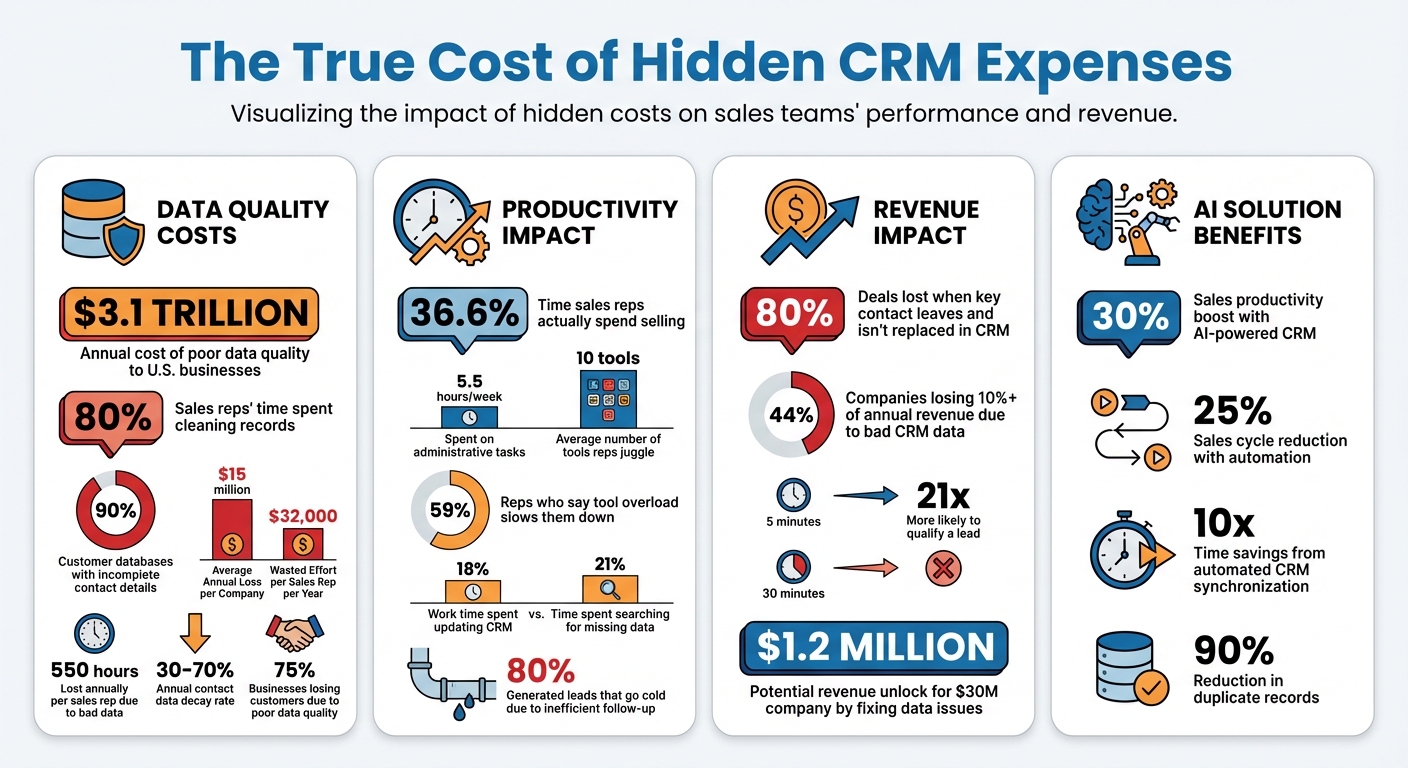
Hidden CRM Costs Impact on Sales Teams: Key Statistics
What Are The Hidden CRM Subscription Costs Sales Teams Often Miss? – Sales Pro Blueprint
Common Hidden CRM Costs and Their Impacts
Hidden costs in CRM systems can quietly inflate expenses and hurt overall performance. Let’s break down three key areas where these costs often arise.
Poor Data Quality
For sales teams, bad data is a productivity killer. When records are inaccurate, incomplete, or duplicated, sales reps spend about 21% of their time digging for information instead of selling [7]. Shockingly, 90% of customer databases have incomplete contact details [7], leaving teams to work with a shaky foundation.
The financial impact is massive. Poor data quality costs U.S. businesses roughly $3.1 trillion annually [5], and the average company loses $15 million per year to data issues [5][6]. For individual sales reps, this translates to 550 lost hours and $32,000 in wasted effort every year [8]. On top of that, contact data decays rapidly – anywhere from 30% to 70% annually [6] – as people change jobs, emails, or phone numbers. What was a hot lead yesterday could be worthless today.
This isn’t just about wasted time or money. Bad data damages customer relationships, too. Seventy-five percent of businesses report losing customers due to ineffective outreach caused by poor data [5]. Reaching out to outdated contacts or sending emails that bounce doesn’t just waste resources – it can hurt your domain reputation and email deliverability across the board. Steve Jones, Global VP at Capgemini, sums it up well:
"Data quality isn’t a business outcome. It’s about the business objective that data quality enables" [7].
And while poor data creates one set of challenges, inefficient workflows pile on even more.
Workflow Inefficiencies
Inefficient workflows drain time and energy from sales teams. On average, sales reps spend 5.5 hours per week on administrative tasks like manual data entry [9], leaving only 36.6% of their time for actual selling [1]. That’s a lot of missed opportunities.
Tool overload makes things worse. With reps juggling an average of 10 different tools, 59% say this slows them down and degrades data quality [2][10]. Switching between platforms creates friction, disrupts focus, and ultimately slows deal progress.
The fallout is costly. Eighty percent of generated leads go cold because of inefficient follow-up processes [8]. And here’s the kicker: responding to a lead within 5 minutes makes it 21 times more likely to qualify than waiting just 30 minutes [8]. These workflow roadblocks don’t just waste time – they leave piles of revenue on the table. As Jordan Joltes, CEO of TruSummit, puts it:
"Adoption is a symptom, not the diagnosis. If users aren’t adopting, it’s usually because it’s too hard to use, doesn’t reflect how they work, or doesn’t give value in return" [11].
But inefficiencies aren’t the only hidden cost. Extra fees can sneak up on you, too.
Integration, Customization, and Support Fees
The price you see on a CRM contract is rarely the final cost. Many platforms tack on extra charges for features that should arguably be included. For example, some vendors charge $125 per month for just 500MB of additional storage once you exceed plan limits [2]. Need round-the-clock support? That might cost an extra 20% of your total license price [2]. Full mobile functionality? Add $50 per month. Offline access? That’s another $25 per user per month [2].
These fees add up fast. More than half (52%) of Salesforce users say the high cost of ownership is their biggest gripe [2]. Custom integrations and workflow tweaks can drive costs even higher. If the default setup doesn’t align with your business needs, you’re forced to pay for premium modules, custom development, or ongoing maintenance for third-party app connections.
The problem isn’t just financial – it’s operational. Many companies end up buying extra "point solutions" to fill gaps in their CRM, which creates more data silos and raises the overall cost of ownership [11]. As Karsten Köhler, a HubSpot Consultant, explains:
"Ultimately, integration isn’t just a technical challenge – it’s also about aligning teams and workflows so that data flows align with real workflows" [8].
How Hidden Costs Hurt Sales Team Performance
Hidden costs in CRM systems can quietly disrupt sales team efficiency, pipeline reliability, and overall revenue generation.
Reduced Pipeline Accuracy
Bad data is a pipeline’s worst enemy. When records are riddled with duplicates, outdated information, or missing details, it’s no surprise that 44% of companies report losing more than 10% of their annual revenue because of these issues [4][5]. Duplicate entries inflate the pipeline, leading to overly optimistic forecasts [12][13]. This can push leadership to set unrealistic targets, leaving teams struggling to meet expectations [5]. Scattered account histories also leave sales reps working with incomplete information, which means they might miss critical details needed to close deals. For example, when a key contact leaves a company and the CRM isn’t updated, 80% of deals are at risk of falling through [5]. An unreliable pipeline doesn’t just create forecasting headaches – it also slows down daily operations.
Lower Productivity and Efficiency
Sales reps live by the clock, but hidden CRM inefficiencies waste their precious time. On average, they spend 18% of their work hours updating the CRM, 9% duplicating efforts in spreadsheets, and another 21% searching for incomplete or missing data [1][7]. That’s nearly half of their time lost to tasks that don’t directly drive revenue. System inefficiencies like manual data entry and toggling between platforms add to the frustration. Duplicate records can cause reps to unknowingly contact the same customer multiple times, wasting effort and irritating prospects. And with contact data decaying at a rate of 30% to 70% annually as people change jobs or locations, reps often chase dead ends instead of focusing on real opportunities [6]. These inefficiencies don’t just waste time – they also cost sales.
Missed Revenue Opportunities
The ripple effects of poor data and inefficiency hit revenue hard. For one, inaccurate lead scoring can misdirect efforts away from high-value opportunities [5]. Incomplete customer profiles make it harder to spot cross-sell or upsell opportunities within existing accounts [1][5][7]. Worse, 75% of businesses admit to losing customers to competitors due to impersonal or inaccurate outreach caused by flawed data [5]. And when 80% of deals fall apart because a key contact isn’t replaced in the CRM, the revenue impact is undeniable [5]. Over time, these issues erode trust in the CRM system itself. Sales reps start avoiding it, which only worsens the data quality. This vicious cycle makes it harder for leadership to identify successful strategies, leaving sales performance unpredictable and revenue goals increasingly out of reach.
sbb-itb-0ae5139
How to Address Hidden CRM Costs
Hidden CRM costs can be managed effectively with the right strategies. By focusing on real-time data verification, standardized processes, and phased implementation, businesses can reclaim lost time and revenue. Here’s how to tackle these hidden expenses.
Invest in Real-Time Data Verification
Contact data can degrade significantly – by as much as 30% to 70% annually [6]. Real-time verification helps maintain accurate information, saving sales reps from wasting time on outdated or incorrect data. Take Singular Genomics, for example. When they partnered with Clari in 2024 to automate data collection and CRM synchronization, they eliminated manual data entry and achieved a remarkable 10x time savings [4]. This not only streamlined operations but also reinforced trust within the sales team, making the CRM a reliable "source of truth" [1].
Real-time verification doesn’t just save time – it prevents larger issues down the line. For instance, verifying email addresses before sending messages reduces bounce rates, which could otherwise result in your company being blacklisted by email providers [6]. It also ensures smooth handoffs between teams and avoids missing critical renewal histories [1]. For a business generating $30 million in annual revenue, redirecting time spent on bad data into actual selling activities could potentially unlock an additional $1.2 million in revenue – all without increasing headcount [1]. Accurate, up-to-date data lays the groundwork for more efficient operations.
Standardize CRM Processes
Before diving into CRM software configuration, it’s crucial to map out your sales journey. Define each stage, identify key touchpoints, and determine the exact data needed at every step [3]. Standardizing data entry rules – like whether to use "St." or "Street", how to format phone numbers, and which fields must be mandatory – can eliminate duplicate records and unsearchable entries that waste hours later [6].
An exception dashboard can be a game-changer, flagging incomplete records and holding team members accountable. By implementing standardized processes, your CRM can function as a centralized, reliable resource rather than just another disconnected data repository.
Use Phased Implementation and Training
Proper implementation is essential to unlocking the full potential of your CRM. Start by integrating core tools, like email, and gradually add others once the initial setup proves effective [3]. Setting clear 90-day goals focused on core functionalities can help avoid "feature creep" and unnecessary costs tied to add-ons [14].
Training is another critical component. Instead of generic sessions, offer role-specific training that shows team members how to handle their daily tasks within the system. Appoint internal "champions" to provide ongoing peer support and keep the momentum going post-launch. Don’t forget to audit and standardize data formats before migration. As Salesforce aptly puts it:
"A botched migration doesn’t just clutter your database – it sows doubt in every click. Incomplete records make even the best CRM feel like an unreliable narrator" [3].
The costs of migration and training can add up – companies with a 10-user sales team often lose between $3,000 and $12,000 in productivity during this phase [14]. However, a phased approach with proper preparation can drastically reduce this disruption, ensuring a smoother transition and better long-term results.
How CRM Copilot.AI Can Help
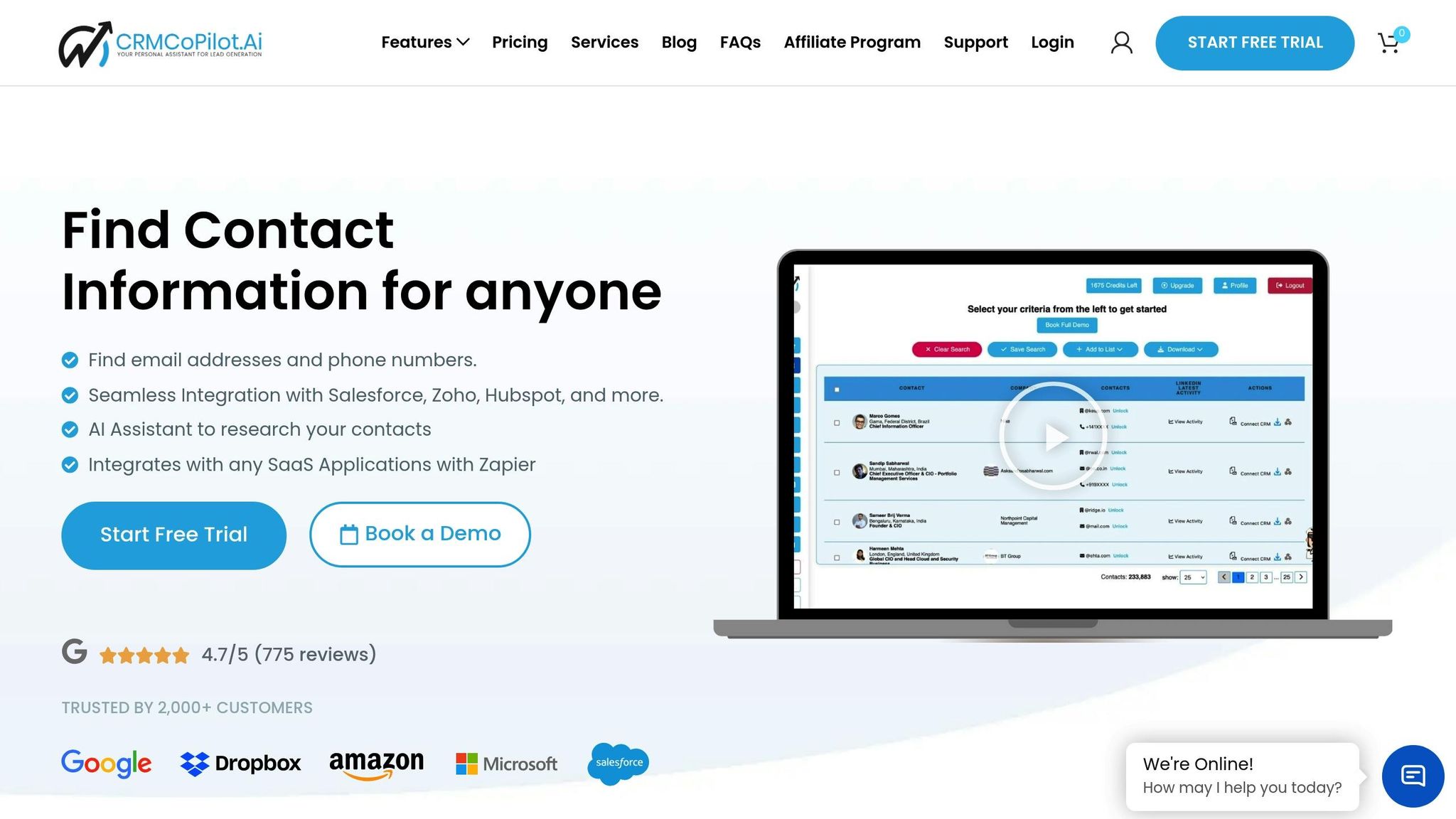
CRM Copilot.AI tackles hidden CRM costs by automating data verification, simplifying integrations, and streamlining workflows. It transforms your CRM from a time-consuming burden into a powerful tool for driving revenue.
AI-Driven Data Verification
CRM Copilot.AI ensures your data stays accurate by automatically verifying email addresses and phone numbers in real time. This helps prevent the kind of data decay that costs organizations an average of $12.9 million annually [1]. Since 80% of deals are lost when a primary contact leaves their role [5], staying on top of accurate contact information is crucial to avoid chasing outdated leads.
With 44% of businesses losing more than 10% of their annual revenue due to inaccurate CRM data [5], automated verification becomes a critical safeguard. It also protects your sender reputation by flagging invalid email addresses before high bounce rates harm your domain’s credibility. For teams spending up to 80% of their time cleaning data instead of selling [5], this feature can free up hours to focus on closing deals.
Easy CRM Integrations
CRM Copilot.AI integrates effortlessly with platforms like Salesforce, Zoho, and HubSpot, eliminating the need for expensive and complex integration projects that can double your CRM budget [18]. Traditional integrations often require detailed data mapping, consultant fees, and ongoing IT support – hidden costs that add up quickly. By providing out-of-the-box compatibility and bi-directional syncing, CRM Copilot.AI ensures smooth data flow without the headaches.
Optrua highlights the challenge with standard integrations:
"Integrations behave like standalone projects. Changes in one system can ripple into others, creating ongoing support and rework… they quickly become one of the largest drivers of unplanned cost" [18].
With its native compatibility, CRM Copilot.AI allows your team to switch CRMs or add new tools without disrupting operations or incurring costly change orders. Combined with its automation features, the platform helps teams operate more efficiently.
Automation for Better Productivity
Sales reps spend only 36.6% of their time selling, while 18% of their time is consumed by CRM tasks [1]. CRM Copilot.AI tackles this inefficiency with automation that enriches contact records using data from over 21 premium sources, improving lead scoring accuracy [17].
The platform automates repetitive tasks like reassigning ownerless accounts, triggering personalized multi-channel outreach, and prioritizing high-intent leads [16][17]. With AI-powered CRM systems shown to boost sales productivity by up to 30% and shorten sales cycles by 25% [15], these automation tools turn CRM inefficiencies into measurable sales improvements.
Conclusion
Hidden CRM costs aren’t just annoying budget line items – they’re silent revenue and productivity killers. Think about this: poor data quality costs organizations an average of $12.9 million every year [1]. On top of that, sales reps spend less than 37% of their time actually selling [1]. The rest? It’s wasted on tasks like manual data entry, fixing errors, and dealing with clunky workflows.
The good news? These problems are completely fixable. With proactive CRM management, you can tackle these costs head-on. As Matt Levinsky from RevOps802 puts it, a CRM doesn’t have to be a "repository of junk" – it can become a reliable "source of truth" [1]. How? By automating data verification as soon as it’s entered, standardizing data formats across teams, and ditching the dreaded quarterly cleanup in favor of continuous monitoring. This way, you prevent data issues before they spiral into bigger operational headaches.
The numbers don’t lie – companies that make these changes see real results. In 2024, Singular Genomics saved their sales reps 10x the time by automating CRM data synchronization [4]. Another business slashed duplicate records by 90%, while a telecom company cut customer churn by 10% in just one year with automated data cleaning [5].
These examples show how a strategic shift can make all the difference. AI-powered tools like CRM Copilot.AI make it easier to move from reactive fixes to proactive management. By setting clear data ownership, creating validation rules to catch errors early, and using AI to enrich records automatically, your CRM can stop being a time sink and start driving real value. When your data is accurate and easy to access, your team can focus on what matters most: building relationships and closing deals.
Don’t let hidden costs drain your sales productivity. With the right strategies, your CRM can be a game-changer for your business.
FAQs
What hidden costs should sales teams watch out for in CRM systems?
Hidden costs in CRM systems often fly under the radar but can seriously affect sales team performance and revenue. One of the biggest culprits is poor data quality – think duplicate entries, incomplete details, or outright inaccuracies. These issues waste time, hurt revenue, and even drive customers away. In fact, research shows that bad data costs U.S. businesses an average of $12.9 million annually.
Other hidden costs include delayed implementation timelines, unexpected charges for integrations or extra environments, and manual processes that bog down workflows. These problems not only eat up resources but also drag down overall productivity.
The solution? Automation and real-time data management. AI-powered tools like CRM Copilot.AI can simplify workflows, ensure data accuracy, and cut out inefficiencies. This allows sales teams to spend less time on admin tasks and more time closing deals.
How does poor data quality hurt sales team performance?
Poor data quality can throw a wrench in your sales team’s performance by making your CRM unreliable. When contact details are outdated, records are duplicated, or key fields are missing, your reps spend more time hunting for accurate information than actually selling. This not only slows them down but also chips away at their confidence in the system, forcing decisions to be made on guesswork instead of reliable data.
The financial toll is hard to ignore. Research reveals that bad data can eat up as much as 27% of a sales team’s time and shrink annual revenue by up to 10%. Problems like missed follow-ups, duplicate outreach efforts, and incorrect lead prioritization contribute to lost opportunities and increased churn. Tools like CRM Copilot.AI offer a way out. With real-time data verification and automated workflows, it ensures your records stay clean and accurate, allowing your team to focus on what matters most – closing deals and driving revenue.
How can sales teams reduce inefficiencies in their CRM systems?
Reducing inefficiencies in your CRM begins with tackling poor data quality and simplifying workflows. Start by ensuring data accuracy. Use tools for real-time verification, automated validation, and regular deduplication to prevent invalid emails, phone numbers, or addresses from cluttering your CRM. These steps save both time and money by keeping your system clean. Regular audits and AI-powered data enrichment can further improve the reliability of your records.
Next, automate repetitive tasks. Activities like lead assignment, follow-up reminders, and activity tracking can be streamlined through automation. Integrating your CRM with other tools allows sales teams to reclaim valuable hours. In fact, studies show that automation can save up to 27% of sales reps’ time while boosting productivity by as much as 20%.
CRM Copilot.AI offers features like real-time data verification, automated workflows, and AI-driven tools to maintain accurate contact information and eliminate duplicates. By embedding these capabilities into your CRM, sales teams can focus on what they do best – selling – while driving better performance and increasing revenue.