
AI helps ensure your emails land in inboxes instead of spam folders by automating critical tasks like managing sender reputation, optimizing send times, cleaning email lists, and analyzing engagement patterns. With email providers enforcing stricter rules – like requiring authentication protocols and low spam complaint rates – AI has become a key tool for overcoming deliverability challenges. Here’s how it works:
- Sender Reputation Management: AI monitors metrics like bounce rates and spam complaints, adjusting sending behavior to maintain trust with email providers.
- Dynamic Send Optimization: AI predicts the best times to send emails based on user behavior, increasing open rates and engagement.
- List Cleaning: AI removes invalid or inactive email addresses, reducing bounces and protecting your domain’s reputation.
- Content Analysis: AI identifies spam triggers in email content, like suspicious links or formatting issues, before you hit send.
- Warm-Up Tools: AI gradually builds trust for new domains by simulating genuine engagement during the email warm-up process.
With email lists degrading by 23% annually and inbox placement rates for high-volume senders dropping to 28% in 2025, AI ensures your campaigns stay effective and reach the right audience.
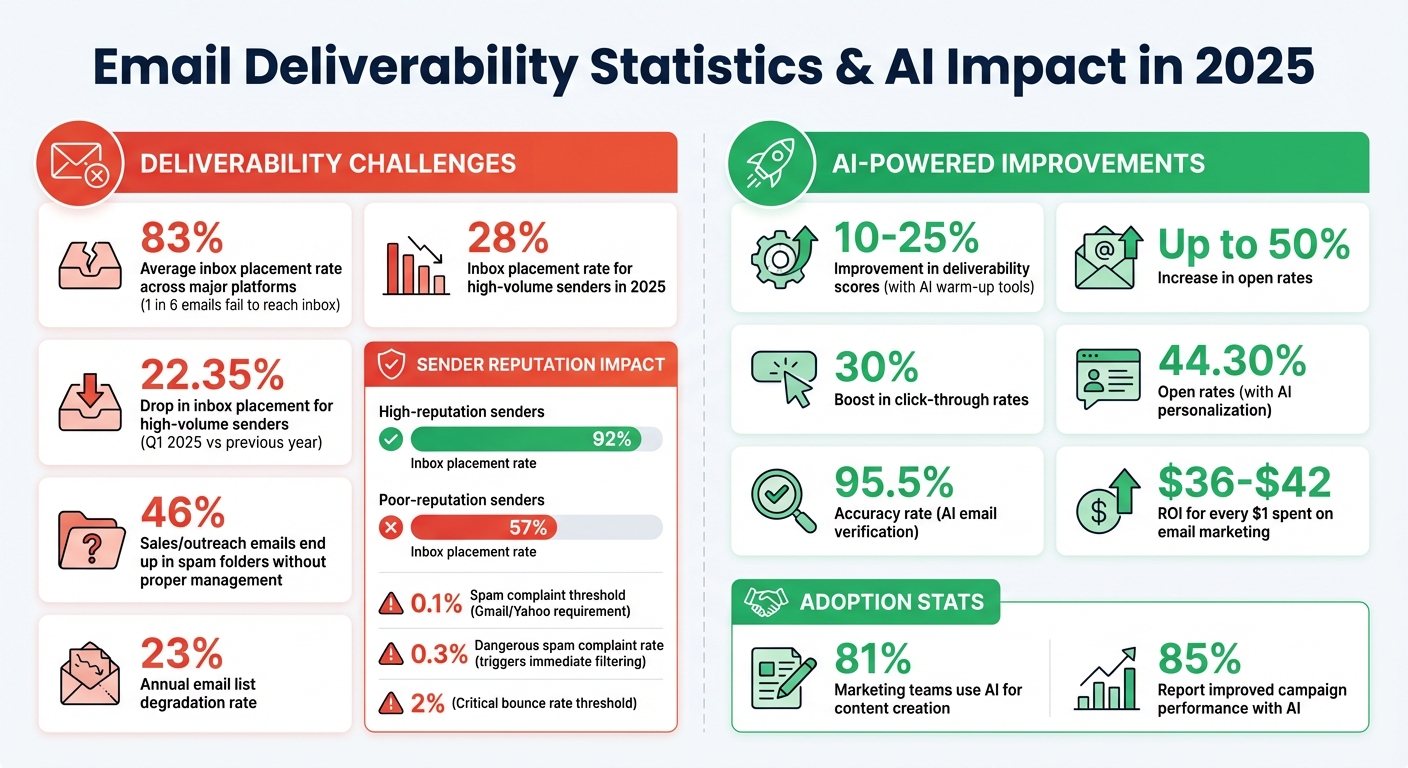
Email Deliverability Statistics and AI Impact 2025
AI Variables – Increase Email Deliverability & Boost Engagement with AI Email Personalization
How Email Deliverability Works and Where AI Helps
Email deliverability goes beyond simply sending an email. While email delivery means the recipient’s server has accepted your message without bouncing back, deliverability determines whether your email lands in the primary inbox or gets lost in the spam folder or promotions tab. On average, about 83% of emails make it to the inbox across major platforms, leaving nearly 1 in 6 messages falling short of their intended destination [2]. This statistic reflects the intricate web of factors that influence whether an email successfully reaches its target.
Main Factors That Affect Email Deliverability
Several key factors determine whether your emails make it to the inbox:
- Sender Reputation: Think of this as a "credit score" for your email-sending domain and IP address. Email providers assess your sending history and engagement metrics to gauge trustworthiness. High-reputation senders enjoy an inbox placement rate of around 92%, while those with poor reputations average just 57% [11].
- Authentication Protocols: Standards like SPF, DKIM, and DMARC verify your identity as a sender. As of 2024, these protocols are mandatory for anyone sending over 5,000 emails daily to ensure authenticity [6].
- Engagement Signals: Recipient interactions – such as opens, clicks, and replies – boost your reputation. On the flip side, spam complaints, quick deletions, and unsubscribes can harm it. Even a spam complaint rate of 0.08% is considered high, and rates above 0.3% could lead to immediate filtering by email providers [6].
- List Quality: An outdated or poorly maintained email list can be a major liability. Bounce rates exceeding 2% signal poor list hygiene and hurt your reputation. Additionally, email lists naturally decay by about 23% annually, accumulating invalid addresses and spam traps over time [5].
These factors show just how critical real-time management is to maintain good deliverability – and this is where AI steps in to make a difference.
How AI Addresses Deliverability Problems
AI provides a powerful, data-driven approach to tackle deliverability challenges and ensure your emails land where they’re supposed to: the inbox.
One way AI helps is by monitoring key metrics like bounce rates, spam complaints, and engagement patterns. If it detects issues – such as a sudden spike in bounces – it can automatically slow down sending speeds to prevent your domain from being blacklisted [1].
AI also excels at dynamic traffic shaping, which adjusts the volume and speed of emails sent to different providers. This technique helps avoid triggering rate-limit filters, ensuring smoother delivery [1]. Additionally, AI can analyze bounce messages to categorize them intelligently. For instance, it identifies whether a bounce is "soft" (temporary) and worth retrying or "hard" (permanent), which requires immediate removal from your list to protect your sender reputation [1].
Another area where AI shines is content optimization. AI tools can simulate spam filters to identify potential red flags in your email – such as trigger words, suspicious links, or formatting issues like an unbalanced text-to-image ratio. By catching these problems early, AI helps safeguard your sender score [2].
"Legitimate senders should be thrilled with Google and Yahoo’s sender requirements. The majority of spammers won’t be able to meet the requirements and your customers’ inboxes will be less cluttered as a result." – Denis O’Sullivan, Principal Deliverability Consultant, Twilio [6]
Using AI to Improve Email Campaign Performance
AI doesn’t just solve deliverability issues – it fine-tunes every aspect of your email campaigns. Beyond ensuring your emails land in inboxes, AI helps you connect with the right audience at the perfect moment, delivering messages that resonate. This includes gradually strengthening your sender reputation, perfectly timing your emails, and ensuring your content consistently clears spam filters.
AI-Powered Email Warm-Up Methods
Launching a new email account or rapidly increasing your email volume can quickly lead to spam folder issues. AI-powered warm-up tools tackle this by mimicking genuine user behavior. These tools send small batches of emails and simulate engagement, signaling legitimacy to providers like Gmail and Microsoft [7]. Unlike older methods that follow rigid schedules, AI adjusts dynamically, factoring in your domain’s age, inbox activity, and real-time reputation metrics [7]. Advanced tools even replicate user reading habits, further building trust with email providers [13]. If a warm-up email lands in spam, AI networks can reroute it to the primary inbox, effectively "training" spam filters to recognize your emails as trustworthy [7].
For example, in 2025, Wishpond integrated an AI-powered warm-up tool into its email strategy. By automating the process and simulating real engagement, the company saw a 10–25% improvement in email deliverability scores. This allowed them to scale their outbound emails without hurting domain health or triggering spam filters [5]. Similar methods have helped businesses achieve up to a 50% increase in open rates and a 30% boost in click-through rates [12].
For best results, maintain the warm-up process for at least 2 to 4 weeks before launching high-volume campaigns. If you’re starting fresh, begin with 20–40 emails daily and aim for a 30–40% reply rate to establish a strong sender reputation [12][13][6].
Once your sender reputation is solid, AI steps in with predictive analytics to determine the best times to send emails.
Finding the Best Send Times with Predictive Analytics
Generic advice like "send emails on Tuesday mornings" might not work for everyone. AI-driven predictive analytics replaces these one-size-fits-all suggestions with personalized scheduling. By analyzing past open rates, click patterns, time zones, and device preferences, AI predicts the perfect time to send emails to each recipient [15]. This ensures your message hits the inbox when they’re most likely to engage, rather than getting buried under other emails [15][6].
Scheduling emails at the right time can significantly improve open rates and drive sales [15]. These systems also adapt in real time, continuously updating predictions as recipient behaviors evolve.
"AI moves email marketing from guesswork to precise timing, giving your campaigns a much better chance of success." – Nukesend Team [15]
To make the most of this, opt for AI tools that integrate with your CRM (like HubSpot or Salesforce). This allows the AI to use existing customer interaction data for even more accurate predictions [15][16]. Be sure the system accounts for time zones to avoid sending emails at odd hours, like 3 a.m. Additionally, sending emails in batches can help you avoid spam filters and the dreaded "Promotions" tab [3].
While timing is key, the quality of your email content is just as important. This is where AI shines in crafting messages that resonate.
AI-Driven Content Optimization
Even perfectly timed emails can fall flat if the content is irrelevant or triggers spam filters. AI takes content to the next level by creating highly personalized messages tailored to individual browsing habits and purchase histories. This goes far beyond basic segmentation, delivering one-to-one communication that can boost open rates to as high as 44.30% [14][16][4].
AI can also analyze recipient sentiment, offering deeper insights into how your emails are received. Instead of just tracking clicks and opens, it evaluates responses and feedback to gauge emotional reactions [16]. Today, 81% of marketing teams rely on AI for content creation, and 85% report improved campaign performance as a result [5].
In 2025, major inbox providers like Apple and Google began using AI to summarize email content and highlight discount codes directly in inbox previews [6]. To stay ahead, marketers should use tools like Schema.org markup and Gmail Annotations to control how their emails appear in these previews [6].
To further optimize results, leverage AI for A/B testing – not just for subject lines, but also for visuals, colors, and other design elements that drive engagement [14]. Sync your AI tools with CRM data to deliver dynamic product recommendations and personalized offers based on each customer’s journey [14]. Additionally, consider using "signs of life" detectors to monitor early engagement. This helps you avoid sending follow-ups to unengaged recipients, reducing spam complaints and protecting your sender reputation [3].
Keeping Email Lists Clean with AI
Even the most well-crafted emails won’t perform if your list is cluttered with invalid addresses. Email lists naturally degrade by about 23% each year [18], meaning nearly a quarter of your contacts become outdated. Sending emails to these outdated addresses increases the chances of bounces and spam complaints, which can harm your sender reputation and cause future emails to land in spam folders.
AI tackles this problem by automating the entire process of maintaining clean email lists. Instead of manually scrubbing your database every few months, AI tools work continuously in the background. They catch invalid data before it enters your system and remove inactive contacts before they hurt your deliverability. This ongoing maintenance keeps bounce rates under 2% [18] and ensures you’re reaching an audience that genuinely wants your emails. Let’s break down how AI achieves this with real-time validation and automated segmentation.
Real-Time Email Validation
Traditional email verification methods involve batch uploads, waiting for results, and then cleaning your list. AI changes the game by validating email addresses instantly during sign-up. When someone fills out a form on your website, AI-powered APIs immediately check the email address, analyzing everything from syntax and domain reputation to mailbox existence and historical engagement patterns [17]. For example, if a user types "gmal.com" instead of "gmail.com", the system catches the mistake on the spot and prompts them to correct it.
This real-time validation goes beyond simple syntax checks. Using machine learning, AI identifies advanced risks like spam traps, disposable email addresses, and fraudulent sign-ups based on unusual IP activity or suspicious timing [17]. The system constantly improves its verification process by learning which addresses engage and which bounce, ensuring better deliverability over time.
The results are impressive: AI-driven validation can cut bounce rates to 2% or below [18], compared to unverified lists where up to 21% of addresses might be invalid. To maximize these benefits, integrate validation APIs directly into your sign-up forms and landing pages. You should also schedule a full list audit every few months – or right before launching a major campaign.
Automated List Segmentation and Cleanup
Once your email list is clean, AI helps maintain its quality by monitoring engagement patterns and automatically managing inactive contacts. For instance, the system flags subscribers who haven’t engaged in 90–180 days [19], applying sunset policies to either re-engage or remove them.
AI also uses behavioral clustering to group your audience based on their preferences and actions [8]. This goes beyond basic demographics, focusing on how different segments interact with your emails. This ensures that your messages are tailored to the most receptive audiences. Additionally, AI can detect changes like job transitions or company rebranding, updating or flagging outdated contact information [20]. These ongoing updates protect your sender reputation and ensure your list stays relevant.
Tools like CRM Copilot.AI integrate real-time data verification with popular platforms like Salesforce, Zoho, and HubSpot. By combining AI-verified contact data with automated workflows, CRM Copilot.AI enriches your database, removes hard bounces, and eliminates inactive addresses – all without requiring constant manual effort. This keeps your sender reputation intact and your campaigns running smoothly.
sbb-itb-0ae5139
Tracking Performance and Improving Results with AI
Once your email list is clean and ready, the real magic of AI kicks in – helping you track performance in real time and fine-tune campaigns as they run. Traditional email analytics might show what happened, like a dip in open rates or a surge in bounce rates. But AI goes further, uncovering why these changes occur and providing actionable steps to address them. For example, if there’s an uptick in spam complaints from Gmail users, AI can automatically adjust the sending speed to that provider to protect your sender reputation [1]. This kind of real-time feedback closes the loop on optimization, ensuring your campaigns stay effective.
Testing Inbox Placement
Before launching full-scale email campaigns, it’s smart to test where your messages will land. AI-powered inbox placement tools use seed accounts across major providers – like Gmail, Outlook, and Yahoo – to check if your email lands in the Primary inbox, the Promotions tab, or the dreaded spam folder [10]. This allows you to tackle provider-specific issues before they affect your campaign’s success.
But this testing isn’t just about delivery. AI also evaluates your email’s content, subject lines, and technical headers to pinpoint elements that might trigger spam filters [9]. Considering that inbox placement for high-volume senders dropped by 22.35% in Q1 2025 compared to the previous year [2], running these tests beforehand is a smart move. It gives you time to tweak your content or technical settings, safeguarding both your sender reputation and your campaign’s reach.
Engagement Scoring and Analytics
AI doesn’t stop at tracking email opens – it builds a full picture of how recipients interact with your messages. Engagement scores are assigned based on actions like clicks, replies, and forwards [14]. These scores help you focus on the subscribers who are genuinely interested, making your efforts more targeted and effective.
Providers like Google and Yahoo enforce strict spam complaint thresholds of 0.1% [10]. Sending emails to disengaged users can push you dangerously close to that limit. AI can help by identifying inactive subscribers. If someone hasn’t engaged with your emails in a while, the system can automatically pause emails to that address [3].
"Sending emails to those who engage with them is one sure-fire signal to the email providers that your emails should go where you send them (and not in a spam folder or promotions tab)." – Larry Kim, Founder, Customers.ai [3]
AI also keeps an eye on real-time anomalies, like sudden drops in engagement or spikes in unsubscribes [1]. For instance, if your open rate plummets unexpectedly, the system will alert you, helping you identify potential issues – whether it’s technical glitches, content fatigue, or deliverability problems. By monitoring metrics for each major provider, you can uncover specific challenges and adjust your strategy accordingly [10]. These insights feed directly into machine learning systems, ensuring your campaigns get smarter over time.
Machine Learning for Campaign Improvement
What sets AI apart is its ability to learn and adapt continuously. Machine learning algorithms analyze data from thousands of campaigns and apply those insights to improve future sends [21]. This includes content optimization – AI can run automated A/B tests on subject lines, email copy, and design elements, predicting which variations will resonate most with specific audience segments [22]. Unlike traditional A/B testing, this all happens in the background, without requiring manual intervention.
As Twilio SendGrid puts it:
"AI-powered email campaigns continue to improve themselves by analyzing data and optimizing campaigns. So if an automated email doesn’t perform well, AI will adjust future campaigns to improve the content, timing, or promotion." – Jesse Sumrak, Twilio SendGrid [16]
Machine learning also handles bounce management intelligently. When an email bounces, the system evaluates the error code. For example, a "mailbox full" error might prompt a retry after 24 hours, while a "user unknown" error would lead to immediate removal of that address [1]. This nuanced approach helps maintain your sender reputation.
Beyond that, AI identifies subtle patterns – like shifts in user behavior, changes in engagement trends, or seasonal variations – that might otherwise fly under the radar [21]. These insights enable more precise segmentation and targeting. For example, predictive send-time optimization can determine the best time to email each subscriber, rather than blasting your entire list at once [21]. Additionally, using Gmail’s Feedback Loop Identifiers to tag campaigns can help track which content types trigger spam complaints, allowing the AI to refine future sends [6].
AI Tools That Improve Email Campaign Results
Specialized AI tools are taking email campaigns to the next level. From maintaining clean email lists to tracking engagement, these tools do more than just automate tasks – they actively safeguard your sender reputation and improve campaign performance by addressing potential issues before they become problems. The secret lies in finding tools that integrate seamlessly with your current systems and offer real-time insights you can act on immediately.
CRM Copilot.AI Features
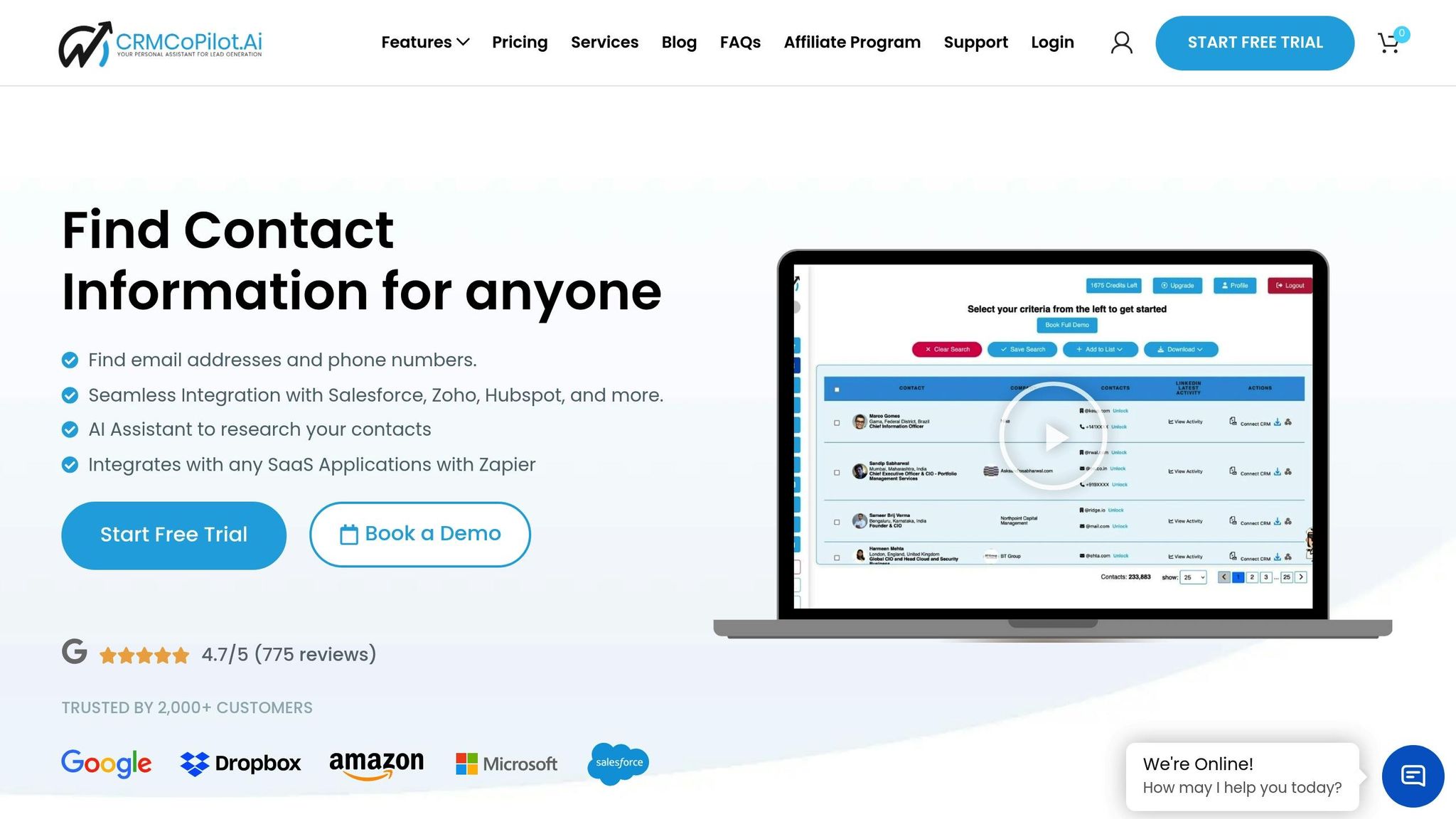
CRM Copilot.AI is designed to enhance email deliverability with its built-in AI capabilities. It combines AI-powered email validation and continuous verification to minimize bounces, undelivered messages, and spam traps [3][7]. This proactive strategy helps protect your sender reputation, which is critical given that nearly 46% of sales and outreach emails end up in spam folders without proper management [7]. By addressing deliverability upfront, you ensure your messages reach their intended audience.
But CRM Copilot.AI doesn’t stop at validation. Its automated lead generation feature identifies high-intent website visitors, capturing their names and emails to build a contact list of people genuinely interested in your offerings [3]. This means you’re not just sending to valid addresses – you’re reaching prospects who are already engaged. The platform’s CRM integration allows for real-time email validation during key moments, like form submissions or just before launching a campaign [17].
The tool also automates workflows within your CRM to handle risky addresses, keep lists clean, and re-verify older contacts [17]. It even identifies the best times to send emails and tailors content recommendations based on previous engagement patterns, ensuring your messages land when recipients are most likely to open them [17]. From lead generation to automated follow-ups, CRM Copilot.AI centralizes all these functions in one place [24]. Its AI-driven verification systems boast an impressive 95.5% accuracy rate, eliminating fake, invalid, or harmful emails like spam traps [23]. This level of precision ensures your emails consistently reach inboxes, driving better campaign outcomes.
Learn more about CRM Copilot.AI
With these features, CRM Copilot.AI demonstrates how focused AI solutions can significantly enhance email campaign success.
Conclusion
AI doesn’t just fix technical deliverability issues; it transforms how email campaigns perform overall. With tools powered by AI, you can monitor sender reputation in real time, use predictive analytics to determine the best times to send emails, spot potential spam triggers before they become a problem, and manage email traffic intelligently to avoid ISP throttling.
Even with these advancements, many emails still fail to make it to the inbox. This is where AI-driven list hygiene becomes critical – it helps remove invalid addresses and spam traps, keeping bounce rates below the crucial 2% threshold [5]. Automated warm-up processes also play a key role, gradually building trust for new domains and ensuring they establish a solid reputation from the beginning.
The challenges are steep. Providers like Gmail, Yahoo, and Microsoft enforce strict authentication protocols and limit spam complaint rates to just 0.3% [6]. These requirements have become the standard for succeeding in email marketing today.
AI-driven tools aren’t just optional – they’re essential for maintaining a strong return on investment. Email marketing continues to deliver an impressive ROI, averaging $36 to $42 for every dollar spent [3]. By incorporating real-time validation, automated workflows, and smarter sending strategies, AI ensures your emails not only reach the right inboxes but also resonate with your audience, driving better engagement and results.
Leveraging AI in your email strategies ensures your messages consistently reach and connect with your audience, helping you make the most of every campaign.
FAQs
How does AI enhance sender reputation to improve email deliverability?
AI takes the guesswork out of managing sender reputation by automating essential tasks to ensure your emails land in the right inboxes. For starters, it can identify and scrub invalid or outdated email addresses from your list, reducing bounce rates and keeping your email hygiene in check. On top of that, AI spots spam-triggering content, guiding you to create messages that meet ISP guidelines and steer clear of spam filters.
But it doesn’t stop there. AI fine-tunes your email sending practices by analyzing data to determine the ideal sending volumes and timing. It also ensures your emails are properly authenticated with protocols like SPF, DKIM, and DMARC, which build trust with Internet Service Providers (ISPs). By keeping your sender reputation in top shape, AI helps improve deliverability rates, ensuring your campaigns consistently reach the right audience.
How does AI determine the best time to send emails?
AI leverages machine learning to dive deep into a recipient’s behavior – tracking patterns like when they usually open or click emails, their time zone, and even what devices they use. Instead of sticking to broad assumptions like "weekday mornings are best", it pinpoints the exact moment each person is most likely to engage.
What’s even better? These predictions don’t stay static. They adapt over time, accounting for shifts in behavior, holidays, or other external factors. By timing emails to align with each recipient’s habits, AI boosts open rates, clicks, and conversions while also lowering the risk of emails landing in spam folders. Tools like CRM Copilot.AI bring this feature to life, ensuring your messages hit inboxes at the perfect time, making campaigns more effective and improving overall deliverability.
How does AI-powered list cleaning improve email campaign results?
AI-driven list cleaning takes the guesswork out of managing your email campaigns. It works by pinpointing and removing invalid or poor-quality email addresses from your contact lists. The result? Lower bounce rates, a stronger sender reputation, and better chances of your emails landing in the inboxes of genuinely interested recipients.
Using tools like CRM Copilot.AI, you can automate this process with real-time data verification. This saves you from tedious manual checks and significantly improves deliverability, open rates, and the overall return on investment for your campaigns. It’s a smart way to boost engagement and make your email marketing more impactful.