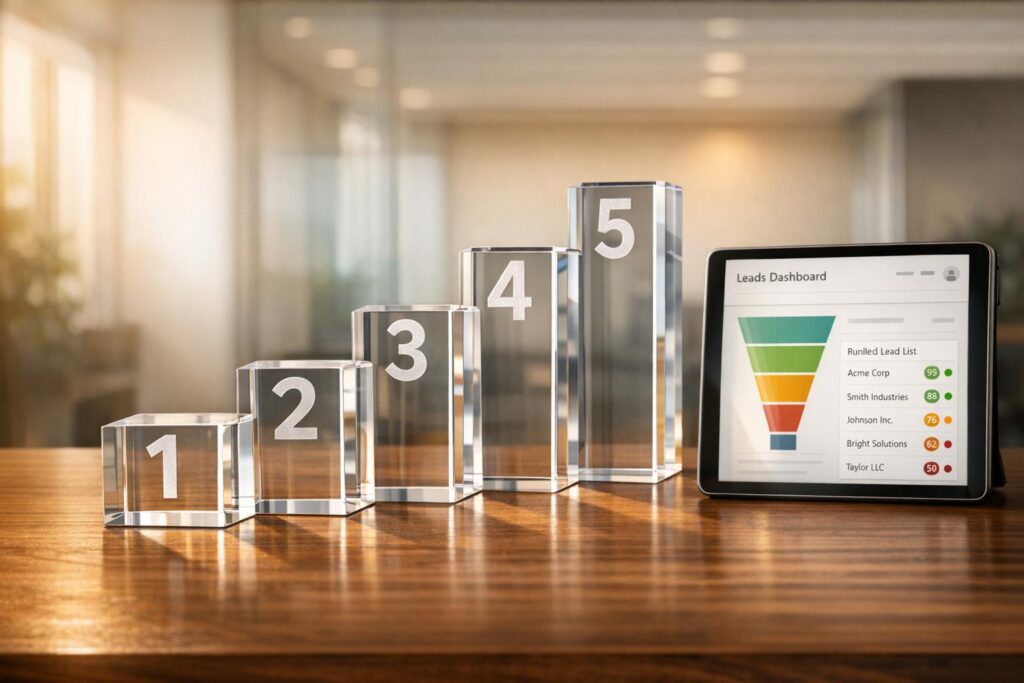
AI lead scoring helps businesses rank potential customers based on their likelihood to convert. Unlike older methods that rely on manual scoring, AI uses machine learning to analyze large amounts of data, such as website activity, CRM records, and third-party information. This makes scoring faster and more precise, helping sales teams focus on high-priority leads.
Key Benefits:
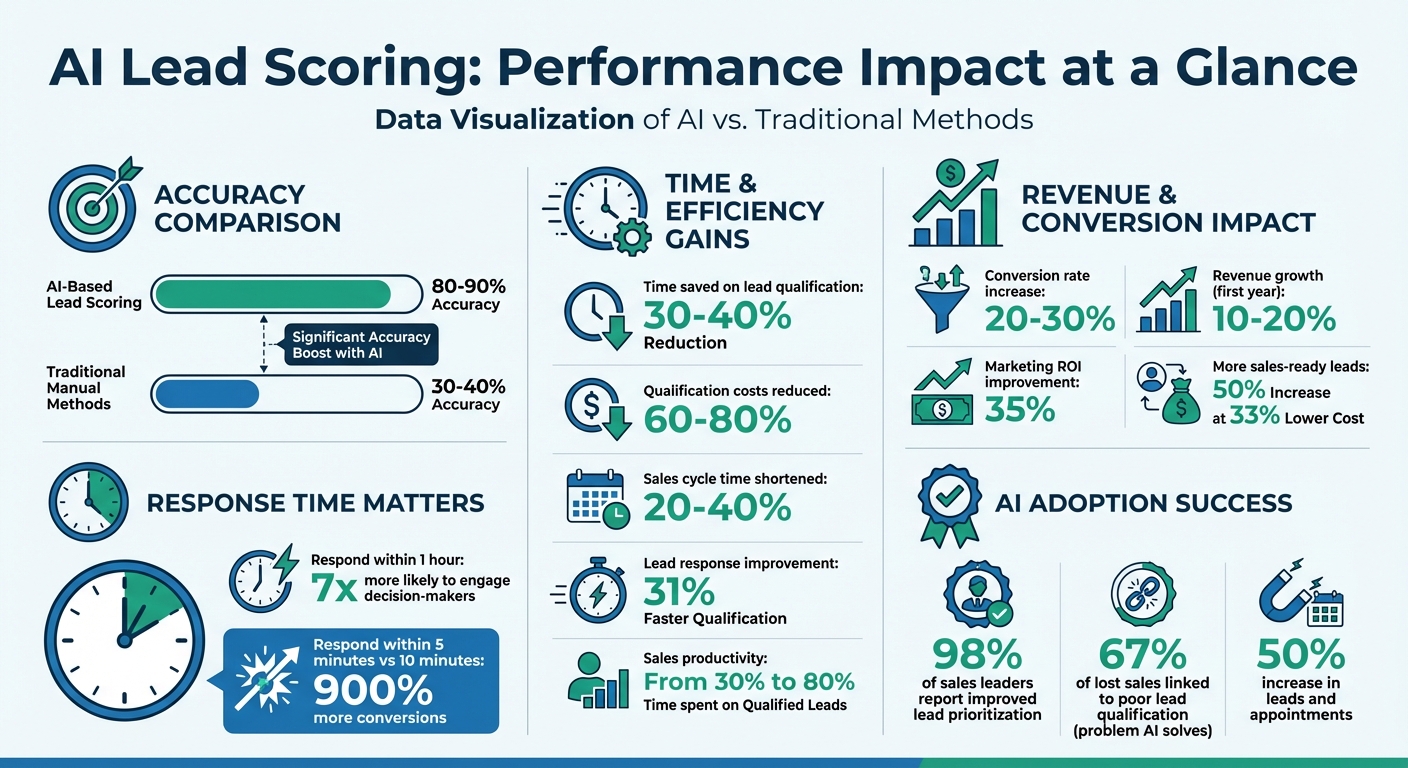
- Higher Accuracy: AI-based lead scoring achieves up to 90% accuracy, compared to 30%-40% for manual methods.
- Improved Efficiency: Sales teams save 30%-40% of their time by automating lead qualification.
- Better Results: Companies using AI see 20%-30% higher conversion rates and reduce sales cycles by 20%-40%.
How It Works:
- Data Sources: AI pulls from CRM data, behavioral signals (e.g., website visits), and third-party enrichment.
- Real-Time Scoring: Scores update instantly based on new engagement, like visiting a pricing page.
- Custom Models: AI tailors scoring based on your business needs, considering factors like job titles and company size.
Metrics to Track:
- Conversion Rate: AI users report a 20%-30% boost.
- Sales Cycle Time: Reduced by 20%-40%.
- Qualification Costs: Cut by 60%-80%.
Platforms like CRM Copilot.AI make implementation simple, integrating with tools like Salesforce and HubSpot in minutes. By automating lead prioritization, businesses can focus on leads with the highest potential to drive revenue growth.
AI Lead Scoring Impact: Key Performance Metrics and Benefits
Benefits of AI Lead Scoring
Better Accuracy in Lead Scoring
AI takes the guesswork out of lead scoring by analyzing thousands of data points – far beyond the handful of factors humans typically consider [9][3]. Instead of relying on subjective judgment or manual weighting, AI uncovers patterns in historical deal data, avoiding mistakes caused by fatigue or emotional bias [1][12].
The results speak for themselves: AI-driven lead scoring achieves 80%–90% accuracy, compared to the 30%–40% range seen with traditional methods [12]. For example, Salesforce users reported a 32% boost in converting prospects to customers after adopting AI for lead scoring [12]. This improvement happens because AI recognizes subtle differences, like understanding that a VP at a startup has different conversion potential than one at a Fortune 500 company – something static scoring systems often miss [9][7].
What sets AI apart is its ability to learn and adapt. As market trends and buyer behaviors change, AI models evolve, ensuring scores remain relevant [10][1]. Updates happen in real time, so if a prospect visits a pricing page, the system adjusts their score immediately [10][3]. This dynamic approach not only improves lead quality but also lightens the load for sales teams.
Time Savings for Sales Teams
AI dramatically reduces the time sales teams spend qualifying leads. Instead of manually researching demographics, company details, or online behavior, AI handles these tasks automatically [14][2]. Considering that 67% of lost sales are linked to poor lead qualification [13], this efficiency is a game changer. In fact, AI-powered tools can cut the time it takes to qualify an inbound lead by 31% [4].
On average, AI reduces the time sales reps spend on initial lead qualification by 30%–40%, slashing qualification costs by 60%–80% [5]. AI works around the clock, meaning leads that come in after hours are scored and enriched by the time sales reps start their day [4][5]. This efficiency can shorten sales cycles by 20%–40%, enabling companies to focus on ready-to-buy prospects while nurturing others over time. Businesses using AI in sales often see a 50% increase in leads and appointments [5][3].
Better Sales and Marketing Alignment
AI doesn’t just improve accuracy and save time – it also bridges the gap between sales and marketing teams. By creating a shared, data-driven definition of what qualifies as a "hot lead", AI eliminates disagreements over lead quality [12][3]. This transparency builds trust, as sales teams are more likely to act on leads scored using clear, historical data rather than arbitrary systems [6].
The impact is measurable: 98% of sales leaders say AI improves lead prioritization, resulting in greater efficiency and revenue [12]. Companies excelling in lead nurturing see 50% more sales-ready leads at a 33% lower cost [16].
AI applies consistent rules to all leads, regardless of their source, reducing errors and streamlining the handoff from marketing to sales [16][3]. This consistency is crucial – companies that respond to leads within an hour are seven times more likely to engage with decision-makers than those that delay [3]. Together, these benefits help businesses refine their lead management process and drive stronger revenue outcomes.
The SIMPLEST Way To Build An AI Lead Scoring Assistant (AI Automation)
Data Sources for AI Lead Scoring
AI lead scoring relies on three key data types to predict lead conversion: CRM data, behavioral signals, and third-party enrichment. Together, these sources provide a comprehensive view that helps rank leads effectively. Let’s break down how each one contributes to the process.
CRM Data
Your CRM serves as the backbone for AI lead scoring models [3][6]. It houses historical data like contact records, deal stages, communication logs, lifecycle transitions, and outcomes – essential elements for machine learning algorithms to identify high-potential leads [3][6][11]. With this information, AI can rank leads in real time based on their likelihood to convert [3][6]. However, the quality of your CRM data is critical. If the data is messy or incomplete, the results will reflect that – essentially a "garbage in, garbage out" scenario [2][3].
Behavioral and Engagement Data
Behavioral data offers a dynamic perspective on buyer intent, capturing signals that static demographics can’t [3][16]. AI tracks actions like website visits (e.g., page views, pricing page visits), email engagement (opens, clicks), content downloads, and event participation to gauge interest in real time [3][17]. Instead of assigning fixed points to these actions, AI evaluates how they interact – considering factors like visit frequency, the sequence of downloads, and the depth of engagement [6][16].
For instance, someone browsing a pricing page on their phone between 7:00 PM and 9:00 PM might be twice as likely to convert [3]. Advanced AI models can even analyze the tone and sentiment of email replies or call transcripts to distinguish between casual inquiries and serious interest [3][16]. This type of "implicit" scoring often proves more accurate than self-reported data because it reflects observed behaviors rather than stated intentions [8][17].
While behavioral data captures immediate intent, it’s third-party data that fills in the gaps to create a complete picture of each lead.
Third-Party and Enriched Data
When internal CRM data falls short, third-party enrichment steps in to complete lead profiles [2][3][17]. This data includes firmographics (e.g., company size, industry, revenue, funding), demographics (e.g., job titles, LinkedIn profiles), and technographics (e.g., current tech stack). These details help AI separate casual browsers from serious buyers.
Platforms often query multiple external data providers to ensure accuracy and detail. Automated systems keep records up-to-date by pulling real-time updates from licensed data partners, eliminating the need for manual uploads. This continuous enrichment allows AI models to adapt quickly to new signals, such as recent funding rounds or the adoption of new technologies, ensuring that lead scores remain current and relevant.
How to Implement AI Lead Scoring
Once you’ve secured high-quality data, the next step is putting AI lead scoring into action. Here’s how to do it effectively.
Step 1: Review Your Current Lead Management Process
Before diving into AI, take a step back and assess your current setup. Look at your monthly lead volume, conversion rates, and response times. For instance, how quickly do you respond to leads? This is critical because responding within an hour makes you seven times more likely to engage decision-makers compared to waiting just one extra hour [3].
Also, evaluate the quality of your CRM data. With 76% of businesses reporting that poor data quality impacts revenue opportunities [12], chances are your data might need some cleanup before introducing AI. This initial analysis provides the foundation for fine-tuning your lead scoring approach.
Step 2: Define Your Ideal Customer Profile
To guide your AI model, you need to define what a "perfect lead" looks like. Start by analyzing your top-performing customers from the past 12–24 months. Look for patterns – what roles do they hold? What company sizes convert most often? Do actions like attending webinars or frequent visits to your pricing page signal higher intent?
Stick to 5–10 key attributes that your sales team already values [17]. Don’t forget to include negative indicators too, like deducting points for personal email addresses or visits limited to your careers page [17][8]. This ensures the AI can identify both strong and weak leads right from the start.
Step 3: Prepare and Integrate Your Data
Next, gather data from all relevant sources: your CRM, marketing automation tools, website analytics, and any third-party enrichment platforms. Clean up this data by removing duplicates, standardizing formats, and filling in missing fields [2][3][12].
Integrate these systems using real-time APIs so lead scores update instantly as prospects interact with your brand [18]. Also, implement data retention policies to delete outdated information, ensuring compliance with regulations like GDPR or CCPA [18]. Once your data is polished and connected, you’re ready to train your AI.
Step 4: Train and Test Your AI Model
This is where machine learning begins. Provide your AI with historical data from both successful and unsuccessful deals to help it recognize patterns that predict conversions [2][10][12]. For reliable results, train your model on at least 1,000 closed leads, including 100 converted ones [10].
Split your data into training and testing sets to evaluate the model’s accuracy before launching it [15]. Set initial scoring thresholds, such as sending leads with scores above 85 directly to sales, while nurturing those in the 50–70 range [1][15][3]. This helps build confidence in your AI system.
Step 5: Monitor and Optimize Performance
AI lead scoring requires ongoing attention. Retrain your model monthly or quarterly to keep up with shifting buyer behaviors and market trends [18][3]. Monitor metrics like conversion rates, sales velocity, and revenue per lead to measure its effectiveness. Use these insights to refine your sales and marketing strategies.
Companies that regularly update their models report a 17% increase in lead conversion rates [18]. Establish a feedback loop with your sales and marketing teams through quarterly reviews to tweak scoring weights and criteria based on recent successes [17][8]. Consistently audit your data, test different scoring approaches, and account for seasonal trends [18][1]. Keeping your model fresh ensures it stays effective over time.
sbb-itb-0ae5139
Metrics for Measuring AI Lead Scoring Success
Tracking the right metrics is essential to understand how well your AI-powered lead scoring system performs. These measurements help confirm the benefits and ensure the system positively impacts your business. Let’s break it down into three key areas that directly influence your results.
Conversion Rate Improvements
One of the clearest indicators of success is your lead-to-customer conversion rate. Calculate it using this formula:
(Converted Leads / Total Leads) x 100 [8].
Before rolling out AI, establish a baseline conversion rate to measure any changes. Keep an eye on conversion rates across different score ranges – leads scoring between 80 and 100 should convert at a higher rate [2][3].
On average, companies using AI for lead scoring report 20% to 30% higher conversion rates [5]. To gauge your specific improvement, use this formula:
[(Conversion rate of AI-prioritized leads – Conversion rate of baseline leads) / Conversion rate of baseline leads] x 100 [2].
Additionally, track precision (how many high-scoring leads actually convert) and recall (how many total conversions the AI correctly identifies). These metrics ensure the model isn’t overlooking potential opportunities [2]. As conversions rise, you’ll likely see improvements in deal velocity and overall revenue efficiency.
Sales Cycle Reduction
AI lead scoring doesn’t just improve conversions – it also speeds up the sales process. By focusing your team on leads ready to buy, deals close faster. To measure this, track metrics like sales velocity and lead response time, as quicker responses often lead to faster deal closures [3][5].
For example, responding within an hour increases your chances of meaningful conversations with decision-makers by seven times [3]. Companies using AI scoring typically report 20% to 40% shorter sales cycles [5].
AI also allows sales reps to focus their time more effectively. Teams often report spending up to 80% of their efforts on qualified leads, compared to just 30% when using manual methods [3]. This shift in focus naturally accelerates the sales process.
Revenue Per Lead
AI scoring doesn’t just improve efficiency – it can also boost your revenue. Start by calculating the average revenue per lead across different score tiers. Higher scores often align with larger deal sizes [3].
Businesses using AI scoring have reported 10% to 20% revenue growth within the first year [5]. Another key metric is lead qualification cost, which measures the expense of moving a lead to the SQL stage. AI can reduce these costs by 60% to 80% by automating manual tasks [5].
Finally, track your marketing ROI. AI often improves ROI by 35% as it reallocates budgets toward channels that generate higher revenue [5].
| Metric | What It Measures | Expected Impact with AI |
|---|---|---|
| Conversion Rate | % of leads becoming customers | 20-30% increase [5] |
| Sales Cycle Time | Days from lead capture to close | 20-40% reduction [5] |
| Qualification Cost | Cost to move lead to SQL stage | 60-80% reduction [5] |
| Sales Productivity | Time spent on qualified prospects | Increase from 30% to 80% [3] |
| Marketing ROI | Revenue per marketing dollar | 35% improvement [5] |
How CRM Copilot.AI Supports AI Lead Scoring
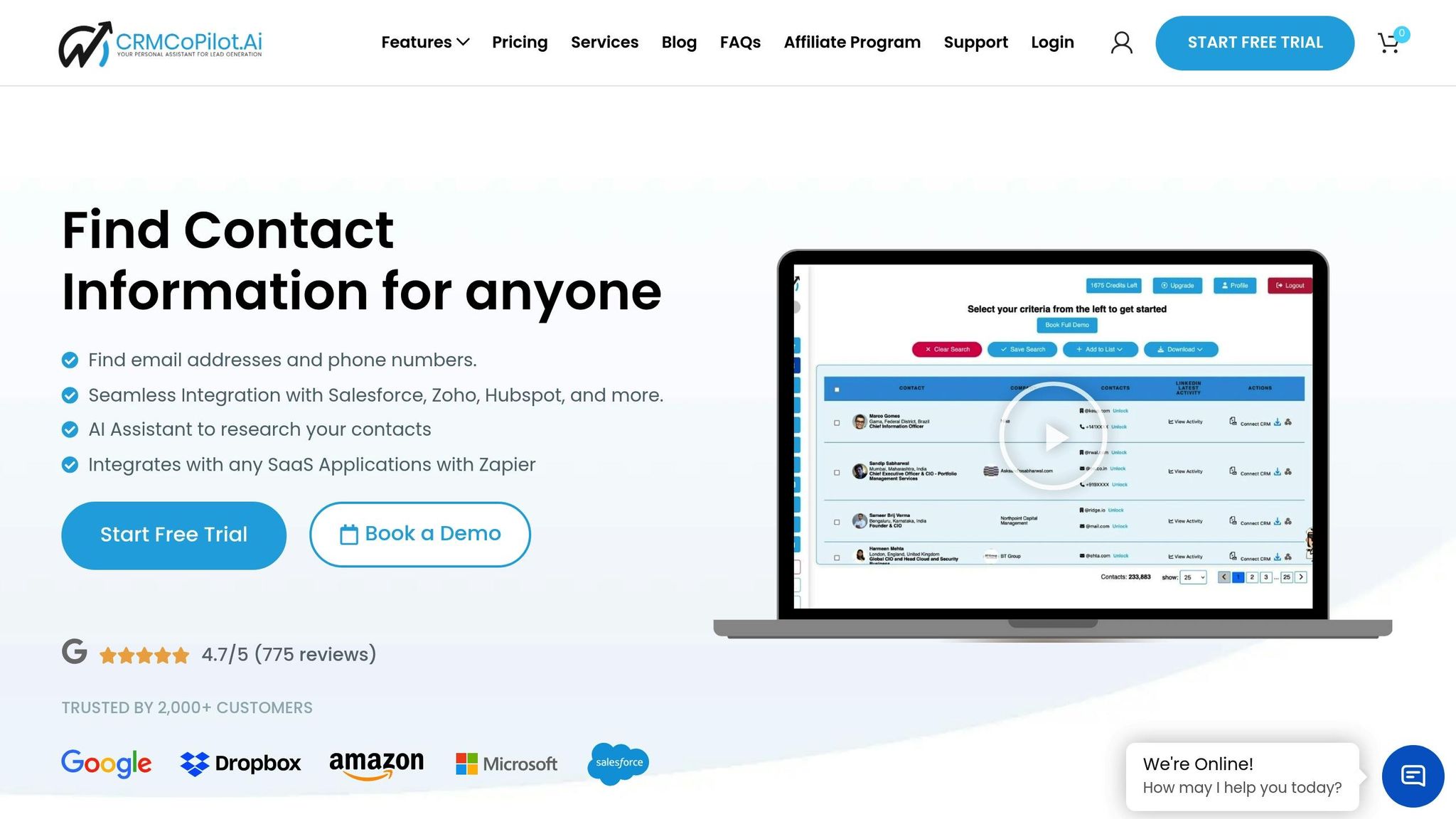
Make AI lead scoring a reality with CRM Copilot.AI, which combines precise data, effortless integration, and full automation to streamline your sales process.
AI-Verified Contact Data
CRM Copilot.AI relies on AI-powered data verification to keep contact details accurate and current. By analyzing vast amounts of data, it can instantly predict the likelihood of a lead converting [3].
The platform also enriches CRM records in real time with the latest firmographic data [3][19]. This ensures your scoring model operates with complete and verified information, eliminating the risks tied to outdated or incomplete records. Sales teams can confidently rely on this enriched data, which is seamlessly integrated into your CRM, providing an up-to-date foundation for lead scoring.
Integration with Popular CRMs
CRM Copilot.AI integrates directly with Salesforce, Zoho, and HubSpot, and the setup takes just five minutes [20]. Once connected, the platform conducts a "Reveal analysis" to determine the scoring factors that most influence conversions [20].
Lead scores are delivered in real time to your CRM, allowing your team to see updated prioritizations without leaving their platform [20]. You can customize fit criteria, activity variables, and weightings to align with your goals. The system’s transparent design explains the reasoning behind scoring decisions, blending machine learning insights with human oversight [20]. With instant integration, the entire prioritization process becomes automated.
Automated Lead Prioritization
CRM Copilot.AI automates lead scoring and prioritization, updating scores immediately as new engagement signals – like a pricing page visit or webinar attendance – come in [20][3]. Timing matters: reaching out within 5 minutes of engagement can increase conversions by 900% compared to waiting 10 minutes [21].
The platform builds custom scoring models tailored to your business needs [20]. As Breadcrumbs highlights:
Copilot… creates custom scoring models tailored to your specific business objectives and needs. With just a few simple clicks, Copilot analyzes your data and generates a comprehensive model that suggests the best approach for you [20].
You can set real-time alerts for "Hot" leads (70+ points) and receive daily updates for "Warm" leads, reducing alert fatigue while ensuring no opportunity is missed [21]. By automating prioritization, CRM Copilot.AI empowers sales teams to focus on leads with the highest potential.
| Feature | Traditional Lead Scoring | CRM Copilot.AI (AI Scoring) |
|---|---|---|
| Speed | Manual updates take hours or days | Instant scoring within seconds [20][3] |
| Accuracy | Prone to human error and static rules | Data-driven; continuously improves [3] |
| Scale | Struggles with high volumes | Handles unlimited leads effortlessly [3] |
| Setup Time | Requires extensive manual configuration | Ready in about 5 minutes [20] |
Conclusion
AI-powered lead scoring is transforming how businesses prioritize leads, driving impressive results like a 20–30% increase in conversion rates and up to a 40% reduction in sales cycles [5]. By learning from every win and loss, this technology adjusts its scoring criteria automatically, staying aligned with evolving market conditions.
Sales teams leveraging AI spend as much as 80% of their time engaging with qualified leads, a significant jump from the 30% achieved through manual methods [3]. This boost in efficiency comes from the ability to instantly prioritize and route high-scoring leads to sales reps. Quick response times matter – a rep who contacts a lead within five minutes of their initial interaction can achieve up to 900% more conversions compared to waiting 10 minutes [21].
Platforms like CRM Copilot.AI simplify this process with AI-verified data, seamless CRM integration, and automated prioritization [3]. These tools make it easier for businesses to move from manual lead management to fully automated systems.
For high-performing teams, AI-driven lead scoring has become a standard practice. Companies using this approach often see a 35% boost in marketing ROI, generate 50% more sales-ready leads, and cut costs by 33% [5][16]. With clean data and the right platform, any organization can tap into these benefits, improving conversion rates, sales efficiency, and overall revenue growth.
FAQs
How does AI-powered lead scoring help boost conversion rates?
AI-powered lead scoring takes conversion rates to the next level by leveraging advanced data analytics and machine learning. Unlike old-school methods that often depend on guesswork or outdated criteria, this modern approach evaluates leads using real-time data and predictive models.
The result? Sales teams can zero in on leads with the best potential, saving time and boosting productivity. Research backs this up: businesses that use AI for lead scoring often see conversion rates jump by 35% to 52% compared to traditional methods. It’s a game-changer for prioritizing high-quality leads and driving better outcomes.
What key data points are essential for accurate AI lead scoring?
AI lead scoring analyzes important data points to predict which leads are most likely to convert into customers. Here’s a breakdown of the key data it examines:
- Web activity: Tracks actions like site visits, clicks, and time spent browsing your pages.
- Email engagement: Looks at metrics such as email opens, link clicks, and replies.
- CRM updates: Reviews details like lead status, notes, and past interactions logged in your CRM system.
- Demographic and firmographic data: Considers factors like a lead’s industry, company size, and job role.
- Behavioral patterns: Spots trends in how leads engage with your brand across various touchpoints.
With these insights, AI tools can rank and prioritize leads, helping your sales team zero in on those with the highest potential. This means less time chasing cold leads and more time closing deals.
How can businesses keep their AI lead scoring models accurate over time?
To keep AI lead scoring models accurate, businesses need to retrain models regularly with up-to-date data. This includes incorporating recent customer interactions, behavior changes, and shifts in market trends. Doing so ensures the model stays aligned with current patterns and remains effective.
Equally important is monitoring the model’s performance. By tracking key metrics, businesses can spot any drop in accuracy early. Making adjustments based on these insights helps maintain the model’s reliability and ensures it continues to meet business objectives.