
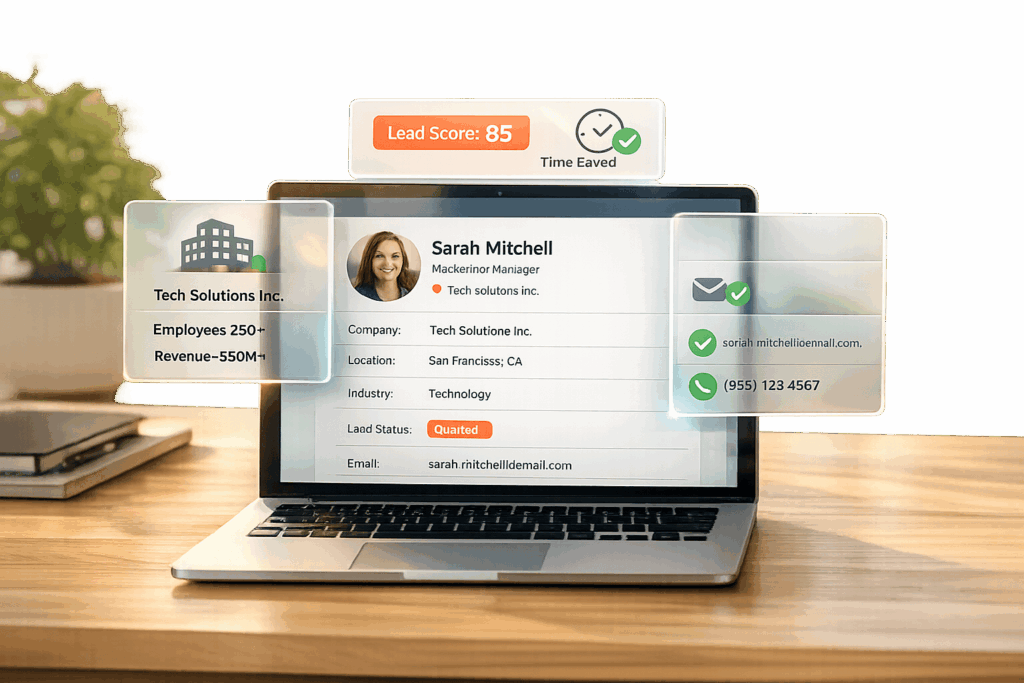
AI tools are transforming CRM data enrichment by automating the process of updating and verifying customer records. This helps businesses combat data decay, reduce manual work, and improve sales performance. Outdated data costs companies millions annually, but AI-powered solutions ensure CRM records stay accurate and actionable with minimal effort. Here’s why this matters:
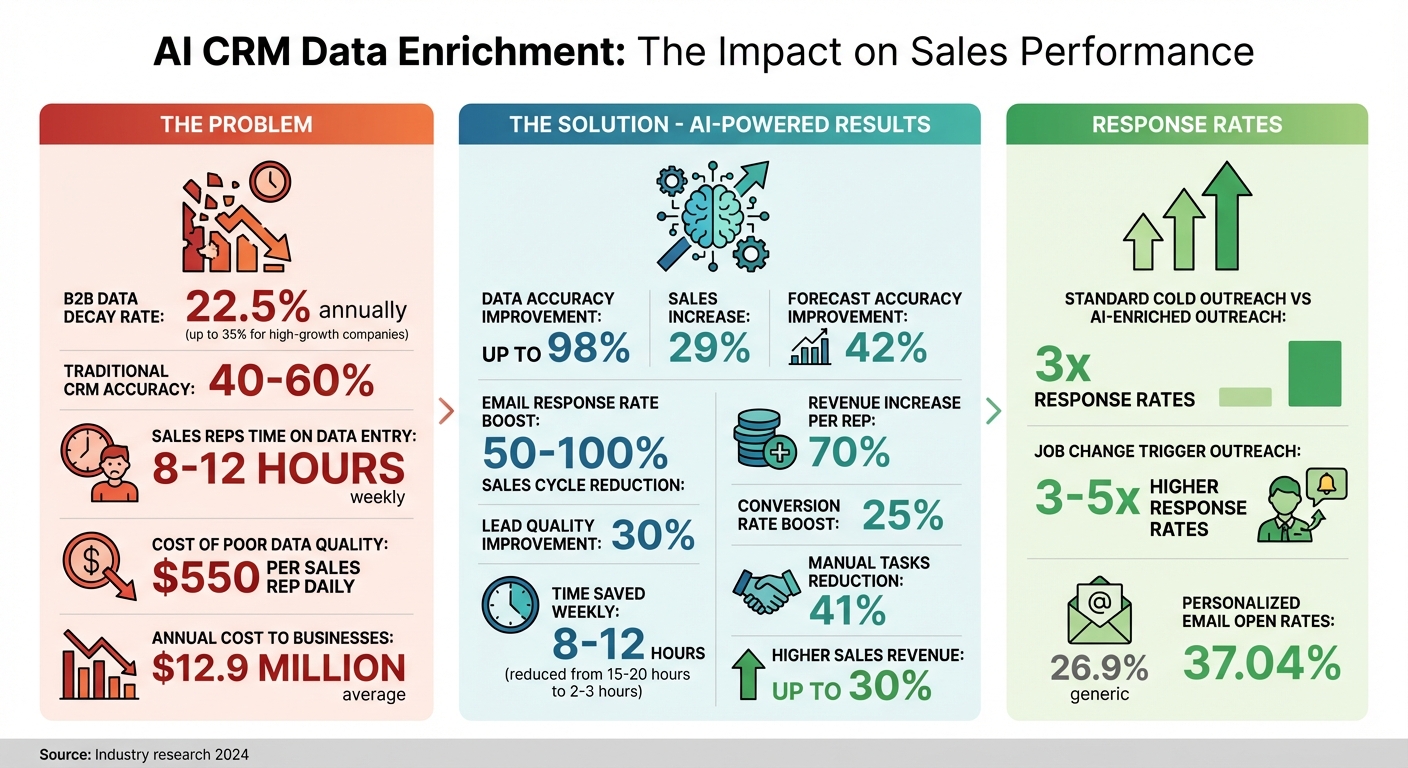
- B2B data decays quickly: 22.5% annually, up to 35% for high-growth companies.
- Manual data entry is inefficient: Sales reps spend 8–12 hours weekly on these tasks.
- AI tools boost results: Companies see 3x response rates, 40% shorter sales cycles, and 70% more revenue per rep.
AI-driven tools like CRM Copilot.AI use real-time data verification, advanced filters, and direct CRM integration to streamline workflows. They automatically update records, extract insights from unstructured data, and personalize outreach, saving time and improving accuracy. Businesses using these tools report higher sales revenue, shorter sales cycles, and better lead quality. With flexible pricing plans, these solutions cater to teams of all sizes.
AI CRM Data Enrichment Impact: Key Statistics and ROI Metrics
How to Streamline and Automate Data Enrichment in HubSpot | Strategic HubSpot Tutorial
sbb-itb-0ae5139
Why AI Tools Matter for CRM Data Enrichment
Keeping CRM data accurate through manual methods is an uphill battle. Sales reps already spend 8–12 hours a week on data entry tasks [7], yet traditional CRM systems only manage 40–60% accuracy [4]. To make matters worse, B2B data decays at a rate of 30% per year [4]. This is where AI-powered tools completely change the game – not just speeding up the process but fundamentally transforming how it’s done.
AI tools gather real-time insights from sources like company websites, news articles, and job postings, ensuring CRM data stays fresh [9]. By cross-referencing 5–7 independent sources – prioritizing official company websites over less reliable platforms like LinkedIn – they constantly re-verify records to counteract data decay [4]. The outcome? Data accuracy levels that can reach 98%, a massive upgrade compared to traditional methods [4].
"Data accuracy isn’t just operational efficiency – it’s a direct revenue driver." – Forrester [4]
The financial impact is clear: poor data quality costs B2B companies around $550 per sales rep daily [4]. On the flip side, automated enrichment can boost sales by 29% and improve forecast accuracy by 42% [2]. By automating routine research, AI allows sales teams to focus on activities that directly drive revenue. This constant data verification leads to better workflows and tangible financial benefits.
Benefits of AI-Driven Enrichment
AI streamlines CRM tasks by reclaiming 8–12 hours weekly for sales reps [7]. It automatically captures contacts and activities from emails and calendars, eliminating the need for manual data entry. Unlike traditional tools that update records every 30–90 days, AI provides continuous updates triggered by real-time events – such as a prospect changing jobs or a company securing new funding [10].
Instead of requiring manual uploads, AI tools work in the background, using a waterfall enrichment method that prioritizes verified sources [11]. They also extract insights from unstructured data, like call transcripts and meeting notes, offering deeper context beyond basic firmographics [2].
The time savings are substantial. Traditional methods demand 15–20 hours per week for data upkeep, while AI tools reduce that to just 2–3 hours, allowing teams to focus on strategic oversight [4]. AI also cuts down manual data-related tasks by 41% [11], enabling reps to prioritize high-value activities like strategic calls instead of tedious data management. These features enhance lead scoring, pipeline accuracy, and personalized outreach.
Common Use Cases for AI in CRM Enrichment
AI’s efficiency directly boosts key CRM processes:
- Lead scoring becomes more accurate as AI continuously updates firmographic details like employee count, industry, and seniority [5]. The system can respond to real-time signals, such as a prospect’s promotion, a company adopting new technology, or a recent funding announcement [8].
- Pipeline accuracy improves through domain-first matching rules that eliminate duplicate records and "phantom accounts" [5]. AI keeps records clean and up-to-date by remapping accounts based on current web activity rather than outdated legacy codes [10]. Companies using advanced enrichment strategies can see up to 30% higher sales revenue [11].
- Personalized outreach thrives with enriched data, boosting email response rates by 50–100% [11]. Reps can reference timely details like a prospect’s job change or a company’s new product launch – details that would take hours to uncover manually. AI also enables progressive profiling, keeping web forms short while filling in missing details in the background [11].
Key Features of AI-Driven CRM Data Enrichment Tools
The most effective enrichment tools focus on three key areas: improving data accuracy, refining targeting, and streamlining workflows.
Real-Time Data Verification and Accuracy
Static data can quickly become outdated, but real-time verification turns it into actionable intelligence. AI-powered tools continuously cross-check records with live sources like company websites, news updates, job boards, and regulatory filings. This ensures your CRM stays current by updating as soon as changes occur.
This feature is critical because 75% of organizations are planning to adopt real-time data enrichment to maintain their competitive edge [3]. The financial impact of poor data quality is staggering, costing businesses an average of $12.9 million annually [5]. Real-time verification combats these losses by constantly validating data and prioritizing information from reliable, official sources.
"When lead enrichment becomes an always-on capability, your team stops doing more with less and starts doing more with more: more signal, more speed, more personalization, and more pipeline confidence." – Ameya Deshmukh, VP of Marketing, Integrail Corp. [5]
Customizable Search Filters
Sifting through generic lists wastes time and energy. AI tools with advanced filtering capabilities let you define exactly what you’re looking for. Whether it’s firmographics, technographics, or demographics, you can create highly targeted lists based on criteria like industry type, employee count, revenue, technology stack, or job seniority.
Some tools even take it a step further with natural language processing. For instance, you can simply type, "VPs of Sales at companies with $10M+ funding", and the AI will generate the list for you [1]. This feature can cut manual research time by as much as 75% [2], freeing up sales teams to focus on outreach instead of data collection. Technographic filters also allow you to identify potential clients based on the tools and platforms they already use, giving you a competitive edge [12].
But the benefits don’t stop at list building. These filters can also automate lead routing. For example, enterprise-level leads can be directed to senior sales teams, while smaller leads go to SMB representatives [12][5]. This level of precision ensures that sales efforts are aligned with the right opportunities, all while seamlessly integrating with your CRM.
Direct CRM Integration
Direct CRM integration ensures that enriched data flows smoothly into your system without manual intervention. By working natively with platforms like Salesforce, Zoho, and HubSpot, these tools eliminate manual data entry, reducing errors and saving sales reps 6 to 12 hours per week [2].
Without integration, enrichment tools can create isolated data silos that fail to sync with your primary CRM [2]. Seamless integration allows enriched data to trigger automated workflows, like updating customer records or launching timely outreach campaigns. For example, AI can process unstructured data from emails or meeting notes and convert it into structured insights, automatically updating CRM fields [14][13]. This ensures your CRM reflects real-time customer interactions accurately.
Another advantage is trigger-based enrichment. You can configure the tool to activate when specific events occur, such as a prospect changing jobs or a company securing new funding. This keeps your campaigns timely and relevant without requiring constant manual updates [2]. By 2026, Gartner predicts over 30% of API demand growth will come from AI tools leveraging Large Language Models [14], making seamless integration an essential feature for any enrichment tool.
How CRM Copilot.AI Enriches CRM Data
Overview of CRM Copilot.AI
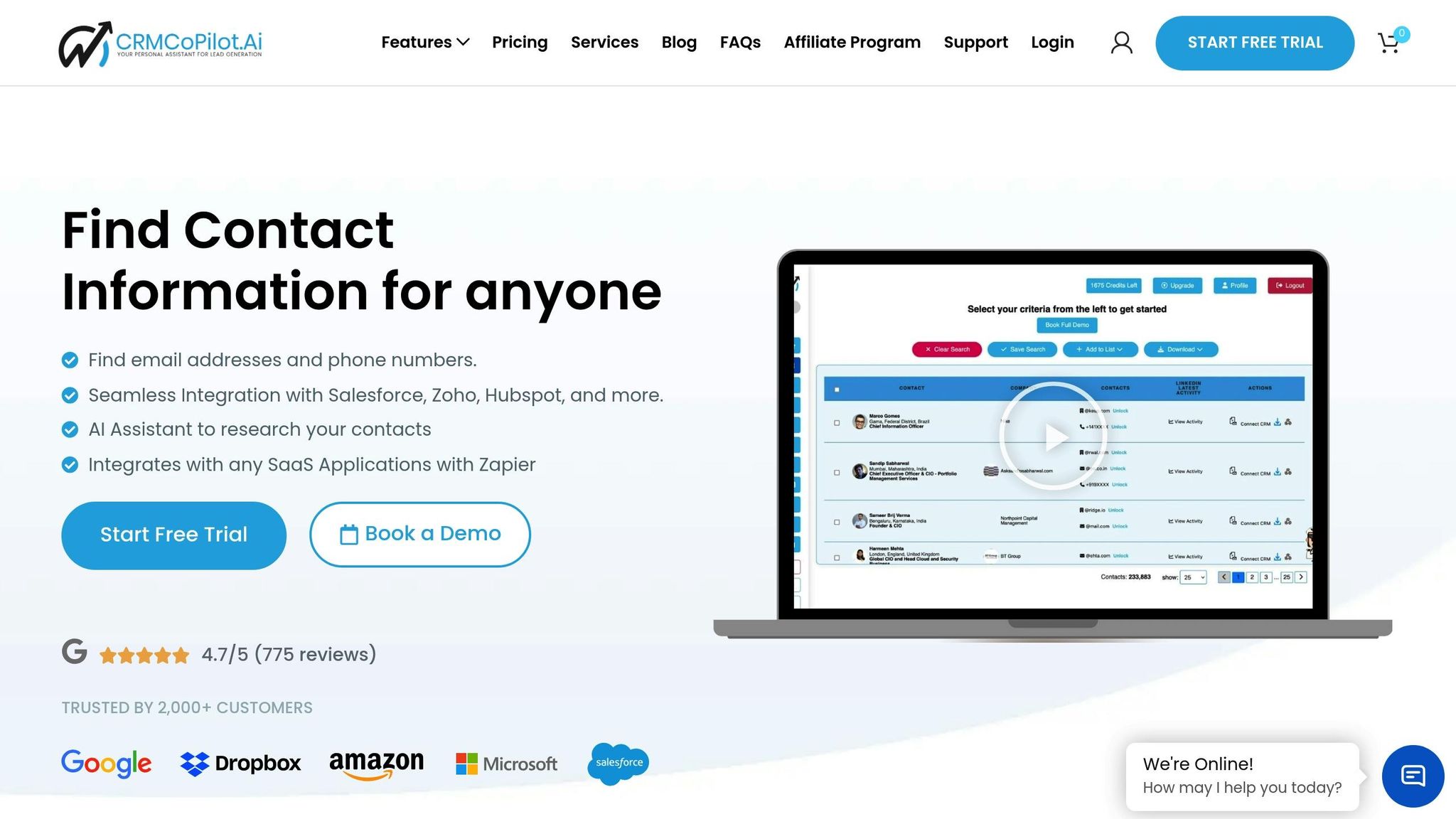
CRM Copilot.AI brings verified, up-to-the-minute contact data straight into your CRM, using AI-powered tools to simplify the process. With over 2,000 customers and an impressive 4.7/5 rating from 775 reviews, it’s ranked as the top lead intelligence software on G2 [15].
The platform relies on LinkedIn Smart Crawl AI and robotic process automation (RPA) to pull accurate, up-to-date leads directly from LinkedIn. A built-in real-time verification system ensures that email addresses and phone numbers are accurate and ready for action [15].
The Ask Your CoPilot AI Assistant takes it a step further by analyzing prospects, gathering additional insights from the web, and evaluating buyer intent. Features like LinkedIn Smart Lookup link email addresses to professional profiles, while CRM AutoPilot keeps lead records in systems like Salesforce, Zoho, or HubSpot up-to-date. You can even schedule updates on specific days and adjust daily lead volumes to align with your outreach goals [16][17]. This seamless integration ensures your CRM is always loaded with enriched, actionable data.
"Saved hours on data entry with CRMCoPilot. The customization options are fantastic, and the tool is compatible with my CRM." – Harleigh Dodson [15]
CRM Copilot.AI also connects effortlessly with major CRMs through one-click exports and offers additional compatibility via Zapier. For teams without a CRM, data can be exported to Google Sheets or Excel. Plus, its AI-powered personalization feature automates LinkedIn SalesNavigator outreach with tailored messaging, transforming enriched data into immediate sales opportunities [16].
By automating data verification and enrichment, CRM Copilot.AI turns basic CRM records into powerful tools for strategic growth. Its features are designed to deliver value across all pricing tiers.
Plan Comparison and Pricing
CRM Copilot.AI offers flexible pricing options tailored for businesses of all sizes, from small teams to large enterprises. Here’s a breakdown of the current plans:
- Free Plan: This entry-level plan costs $0 per month and includes 240 email credits annually, along with basic search filters. Perfect for testing the platform’s capabilities.
- Silver Plan: At $55 per month, this plan adds 1,800 email credits annually, 150 phone credits annually, and advanced search filters for more robust lead generation.
- Gold Plan: Priced at $95 per month, it includes 3,600 email credits annually, 240 phone credits annually, CRM integration, and LinkedIn Smart Crawl for deeper insights.
- Platinum Plan: Designed for enterprise teams, this plan costs $250 per month (billed annually) and offers 7,200 email credits annually, 480 phone credits annually, full automation, and AI-driven workflows.
| Plan | Monthly Price | Email Credits (annually) | Phone Credits (annually) | Key Features |
|---|---|---|---|---|
| Free | $0/month | 240 | N/A | Basic search filters |
| Silver | $55/month | 1,800 | 150 | Advanced search filters |
| Gold | $95/month | 3,600 | 240 | CRM integration, LinkedIn Smart Crawl |
| Platinum | $250/month* | 7,200 | 480 | Full automation, AI-driven workflows |
*Platinum plan pricing is billed annually.
"CRMCoPilot made lead generation a breeze! The automation is seamless, and I’ve seen a significant boost in my efficiency." – Kingsley Chandler [15]
Best Practices for Using Enriched Data in CRM Workflows
Automating Lead Scoring and Outreach
Using enriched CRM data can transform how you handle leads, making the process more precise and efficient. By aligning enriched data with your CRM workflows, you can automate lead prioritization based on your Ideal Customer Profile (ICP). Instead of spending hours on manual research, AI-driven scoring models analyze firmographic and technographic details to rank leads instantly. This approach ensures you’re reaching out to the right people – whether they’re decision-makers or influencers – before making contact.
Behavioral signals like website visits, email clicks, or content downloads provide additional clues about a prospect’s buying intent. Combining these intent signals with firmographic data and engagement levels creates a scoring system that highlights high-value prospects first [23]. Real-time data verification further enhances accuracy by keeping the information current.
The results speak for themselves. AI-driven strategies can improve lead quality by 30% and boost conversion rates by 25% [18]. Automation also significantly cuts down sales cycles – by as much as 40% to 50% – compared to traditional methods, which often add weeks due to manual research [6].
"Manual data entry isn’t just a nuisance. It’s a revenue killer." – Ben Asfaha, CEO of PipeLaunch [18]
Enriched data also makes large-scale personalized outreach possible. With insights like job titles, seniority levels, or recent company developments, you can craft outreach messages that truly resonate. Personalization pays off – emails tailored to the recipient achieve open rates of up to 37.04%, compared to 26.9% for generic ones [22]. Job change triggers, in particular, can generate response rates 3 to 5 times higher than standard cold outreach [21].
Once you’ve optimized lead scoring and outreach, the next step is setting up conditional triggers to keep your data fresh.
Setting Up Conditional Enrichment Triggers
Automating data refreshes with conditional triggers is key to maintaining actionable CRM data without relying on manual updates. These triggers activate enrichment workflows based on specific actions or criteria, ensuring your data stays relevant and up-to-date.
For example, event-driven triggers – like form submissions or demo requests – can prompt immediate enrichment. Responding to these leads within five minutes can increase qualification success tenfold [19]. To manage costs effectively, you can implement tiered enrichment logic. Basic enrichment (such as email or LinkedIn profiles) can be applied to all leads for identity verification, while full enrichment (like direct phone numbers) can be reserved for prospects matching your ICP [20][21]. Using "hold-until-ready" flags ensures leads are only routed to sales teams after enrichment and verification are complete [19][20].
A waterfall approach to data enrichment can further improve accuracy. By querying multiple providers sequentially, you can increase fill rates by 20% to 30% compared to relying on a single source [20]. To maintain data integrity, set overwrite rules that refresh outdated records while preserving manual entries from sales reps [21].
Regular maintenance is non-negotiable. B2B data decays at a rate of about 3.6% per month, or 25% to 30% annually [19][21]. Automate frequent re-enrichment – weekly for fast-changing fields like job titles and monthly for slower-changing ones like revenue [21]. For instance, in 2024, Remote.com used an automated workflow to refresh over 100,000 accounts every 45 days, achieving 98.9% data accuracy while cutting SDR research time by 40% [19].
"Lead enrichment is not a ‘project.’ It’s an operational layer that needs to run continuously – like demand capture itself." – Ameya Deshmukh, EverWorker [5]
To maximize enrichment effectiveness, standardize data at the point of ingestion. Normalize company names, job titles, and country codes to improve match rates and segmentation accuracy. Use confidence thresholds to ensure only high-confidence data (90% or above) is auto-written, flagging lower scores for manual review [20][5]. Lastly, keep detailed logs of data sources to stay compliant with regulations like GDPR and CCPA [19][21].
Conclusion
AI-powered CRM data enrichment has become a game-changer for sales teams, providing a noticeable edge in performance. Companies leveraging enriched data report up to 29% higher sales and experience 42% greater forecast accuracy [2]. With 71% of sales reps saying they spend too much time on manual data entry – leaving only 35% of their day for actual selling – automation has shifted from being a luxury to a necessity [1][7].
Modern enrichment tools go beyond simply filling in missing data; they now handle autonomous workflow execution. AI agents actively monitor for events like job changes or funding announcements, automatically update records, and initiate tailored outreach – all without human intervention. This automation frees up 8 to 12 hours per week for sales reps, allowing them to focus on high-impact selling activities [1][2][7].
"The win isn’t cutting people – it’s giving your best people leverage, so they spend time on strategy, creative, and growth bets instead of record repair." – Ameya Deshmukh, EverWorker [5]
These advancements are reshaping CRM workflows with tools like CRM Copilot.AI, a standout example of this new era. It combines real-time data verification, seamless CRM integration, and automated workflows. Features like AI-verified contact data, customizable search filters, and multi-channel engagement empower sales teams to maintain accurate, actionable data without the hassle of manual updates. With pricing options ranging from free to enterprise-level, it’s designed to meet the needs of teams of all sizes.
FAQs
How do AI enrichment tools verify CRM data in real time?
AI enrichment tools keep CRM data accurate by syncing with sources like email, calendars, and external databases in real time. They handle tasks like updating and validating contact details, company information, and activity records automatically, ensuring your data stays current and reliable.
What CRM fields should be enriched most often?
The most frequently enriched CRM fields typically include firmographics (such as industry, employee count, and annual revenue), contact details, and technographics. By enriching these fields, businesses can maintain more comprehensive data, leading to better sales forecasting and more precise targeting strategies.
How can I set triggers so only high-value leads get full enrichment?
To make sure only the most promising leads receive full enrichment, set up trigger-based automation within your CRM. Define specific criteria such as firmographics, engagement levels, or how closely a lead matches your ideal customer profile (ICP). Once these conditions are met, the AI tool will automatically enrich those leads. This approach cuts down on manual tasks, ensures your data stays accurate, and helps your sales team focus their energy on high-potential prospects.