
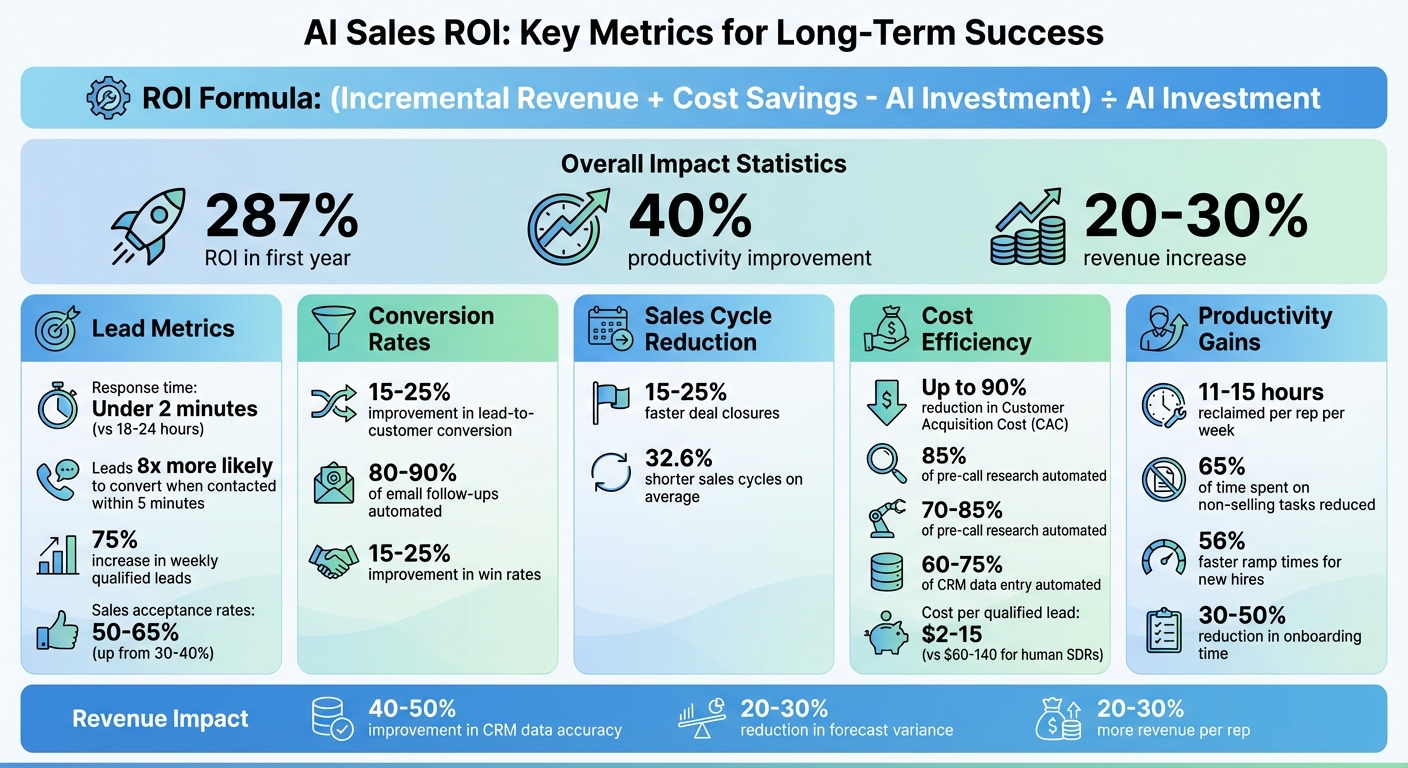
AI sales tools are transforming how companies measure success, moving beyond just cost savings to directly impacting revenue growth. The formula for AI sales ROI is simple: (incremental revenue + cost savings – AI investment) ÷ AI investment. Companies using AI in sales are seeing up to 287% ROI in the first year, with productivity improvements of 40% and revenue increases of 20–30%. Yet, many businesses fail to track the right metrics, leading to missed opportunities.
Here’s what matters most for tracking AI-driven sales performance:
- Lead Metrics: Growth in qualified leads, faster response times (under 2 minutes), and more meetings booked.
- Conversion Rates: AI improves lead-to-customer conversion by 15–25% through better personalization and lead quality.
- Sales Cycle Reduction: Deals close 15–25% faster with automated tasks like follow-ups and scheduling.
- Cost Efficiency: AI cuts Customer Acquisition Costs (CAC) by up to 90%, automating up to 85% of pre-call research and other repetitive tasks.
- Revenue Retention: Improved forecasting accuracy and upsell opportunities boost long-term revenue from existing customers.
To measure success, combine leading indicators (like response times and lead quality) with lagging outcomes (like revenue growth and win rates). Establish baselines, use control groups, and track both short-term and long-term impacts to build a clear ROI framework.
AI isn’t just about saving time – it’s about turning saved time into revenue. Companies that focus on the right metrics can achieve faster deal cycles, higher productivity, and stronger revenue growth.
AI Sales ROI Key Metrics and Performance Improvements
The REAL Way to Measure AI ROI (Hint: It’s Not Usage) | AI Strategy 2026
sbb-itb-0ae5139
Core Metrics for Measuring AI Sales ROI
Tracking the right metrics is what separates AI tools that genuinely boost sales performance from those that merely churn out activity logs. The focus here is on how AI directly enhances sales outcomes and revenue, not just its ability to save time.
Lead Volume Growth
Metrics like Sales-Accepted Lead (SAL) and Sales-Qualified Opportunity (SQO) rates reveal whether AI-generated leads are actually accepted by your sales team. AI tools often improve sales acceptance rates by 15–25 percentage points, increasing rates from 30–40% to 50–65% [7].
Another important metric is account and contact coverage, which measures engagement levels across targeted accounts and stakeholders within a specific timeframe [6]. To gauge how well your messaging resonates, track the positive reply rate – this includes responses showing interest or requesting meetings but excludes out-of-office replies and unsubscribes [6].
Speed also matters. Lead response time has a huge impact on conversions; leads are 8x more likely to convert when contacted within the first 5 minutes. AI tools can cut response times from 18–24 hours to under 2 minutes [7]. For example, platforms like CRM Copilot.AI automate quick, relevant replies to inbound inquiries and ensure follow-up sequences are fully covered.
The ultimate metric? Meetings booked. This measures how many new meetings AI activity generates [6]. AI qualification processes can boost the number of weekly qualified leads by 75% [7], directly creating more opportunities for your sales team.
Once you’ve got qualified leads, the next step is improving how many convert into actual customers.
Conversion Rate Improvement
AI doesn’t just bring in leads – it helps turn them into paying customers. To pinpoint where AI has the most impact, track lead-to-opportunity and opportunity-to-customer conversion rates separately.
One of AI’s biggest strengths is personalization at scale. By analyzing account history, industry trends, and prior interactions, AI delivers tailored outreach that minimizes early-stage drop-offs. It can also handle 80–90% of email follow-up sequences [4], keeping leads engaged while reducing burnout for your sales reps.
AI tools also act as a filter, qualifying leads through conversations before passing them to Account Executives (AEs). This ensures AEs focus on high-quality prospects, improving handoff quality and boosting conversion rates. Companies with mature AI systems report a 15–25% improvement in win rates due to better insights and coaching [4].
Sales Cycle Acceleration
AI can significantly shorten the time it takes to close deals. Deal cycle compression measures how much AI reduces the average time from first contact to a closed deal. With advanced AI tools, sales cycles can be shortened by 15–25% [5]. This is achieved by automating tasks like meeting scheduling, pre-call research, and CRM data entry, freeing up reps to focus on selling.
Another key metric is the opportunity progression rate, which tracks how efficiently deals move through the pipeline. AI tools help by automating follow-ups and scheduling, reducing the number of stalled deals [5].
A short-term indicator of velocity is meeting-to-summary turnaround. AI-generated recaps allow reps to quickly move to the next action item without delays [5], keeping deals from losing momentum.
Faster deal closures also reduce costs, paving the way for lower Customer Acquisition Costs (CAC).
Customer Acquisition Cost (CAC) Reduction
AI slashes CAC by shifting sales reps’ focus from administrative tasks to actual selling. On average, sales reps spend just 2 hours a day selling [4], but AI changes that by automating routine tasks.
Key automation metrics include:
- 70–85% of pre-call research
- 60–75% of CRM data entry
- 80–90% of email follow-ups [4]
These efficiencies translate into direct cost savings. For instance, AI qualification can cut the cost per qualified lead by 59–90%, reducing it to $2–$15 per lead compared to $60–$140 for human SDRs [7].
Tools like CRM Copilot.AI further drive down CAC by integrating with platforms like Salesforce, Zoho, and HubSpot to automate workflows. Real-time data verification and CRM automation mean your team spends less time on manual tasks and more time closing deals.
AI also accelerates onboarding. Acting as a knowledge hub, AI tools help new hires get up to speed faster by providing instant access to critical information [5]. A shorter ramp-up time lowers the cost of getting reps to full productivity.
Net Revenue Retention (NRR) and Expansion
Net Revenue Retention (NRR) measures how much revenue you retain and grow from existing customers. AI influences NRR by improving forecast accuracy, identifying upsell opportunities, and maintaining strong customer engagement.
For forecasting, AI tools improve CRM data accuracy by 40–50% [5], leading to a 20–30% reduction in forecast variance [5]. This helps teams spot at-risk accounts and identify opportunities for growth well in advance.
Long-term metrics like customer lifetime value (CLV) and upsell rates capture AI’s financial impact. AI-driven insights reveal which accounts are ripe for expansion and which require attention to prevent churn. This ensures your team has the right data to make informed decisions that sustain growth.
"The ROI of Copilot AI sales enablement software shows up in revenue moments, not in generic productivity reports." – Chirag Bhardwaj, VP – Technology, Appinventiv [5]
Measuring Productivity Gains from AI Sales Tools
AI doesn’t just save time – it transforms it into revenue. Studies show that the average sales rep spends about 65% of their week on non-selling tasks [8]. In a standard 40-hour workweek, that leaves only 14 hours for actual selling.
By automating tasks like CRM data entry (6–8 hours), follow-ups (3–4 hours), and meeting scheduling (2–3 hours), AI tools reclaim 11–15 hours per week for each rep [8]. Alex Tanaka sums it up perfectly:
"If your reps reclaimed just 6 of those 18.9 admin hours, they’d increase selling time by 43% – from 14.1 to 20.1 hours per week. That’s the difference between missing and crushing quota" [8].
But time saved is only part of the story. It’s essential to measure how these reclaimed hours lead to real results. For instance, instead of simply celebrating "200 hours saved", look at how those hours are used. 200 saved hours could mean 40 additional qualified meetings and 10 new opportunities [1]. Tools like CRM Copilot.AI, which automates workflows and enriches data, allow reps to focus on high-value tasks like engaging with prospects rather than tedious data entry.
AI also accelerates onboarding, another key productivity metric. Companies using sales enablement technology report ramp times that are 56% faster [9], while AI specifically slashes onboarding time by 30–50% [5]. Reducing onboarding time by even one month can increase a rep’s first-year revenue contribution by 15–20% [9]. AI-powered tools simplify knowledge retrieval and provide instant access to critical information, helping new hires hit their first quota faster and boosting overall team productivity.
Finally, tracking revenue per rep offers a clear picture of AI’s impact. With AI tools, reps achieve up to 40% higher productivity and drive 20–30% more revenue [5]. These gains come from faster deal cycles – sales cycles are, on average, 32.6% shorter [2] – better conversion rates, and the ability to manage more opportunities simultaneously. The result? Bigger deals closed faster, all without increasing headcount. These efficiency improvements amplify every productivity metric, underscoring the ROI of AI in sales.
Building a Framework to Track AI ROI
Measuring the return on investment (ROI) for AI in sales isn’t something you do once and forget. It’s an ongoing process that requires a clear and structured framework to track performance over time. Without this structure, proving ROI to finance teams becomes a guessing game. By building on the metrics discussed earlier, this framework provides a way to continuously monitor and refine AI-driven sales performance.
Setting Key Performance Indicators (KPIs)
Start by categorizing your KPIs into two types: leading indicators (predictive metrics) and lagging indicators (outcome-based metrics). Leading indicators, such as speed-to-lead and meeting set rates, show progress within weeks. Lagging indicators, like win rates and sales cycle length, demonstrate financial impact over longer periods, such as quarters.
Bryan Bayless, VP of Revenue Center of Excellence at Gong, explains it well:
"To prove the value of AI and scale it effectively, revenue leaders need to measure their return on investments (ROI) through a combination of leading and lagging indicators tied directly to business outcomes" [10].
To simplify the evaluation process, combine key outcomes into a composite ROI score: Revenue Velocity (40%), Productivity Amplification (30%), Strategic Effectiveness (20%), and Organizational Learning (10%) [3]. This weighted score provides a single, easy-to-understand number for executives while still giving a full picture of performance. For instance, if an AI tool doubles email response rates, calculate how that improvement impacts outbound pipeline and total revenue [3].
Focus on metrics that drive value for specific roles. For example:
- Sellers: Track opportunity velocity.
- Managers: Measure forecast variance reduction.
- RevOps: Monitor improvements in data quality [5].
Platforms like CRM Copilot.AI can simplify this process by automatically logging AI-generated activities into your CRM, ensuring accurate and seamless data capture [11].
| KPI Category | Leading Indicators (Predictive) | Lagging Indicators (Outcome) |
|---|---|---|
| Revenue/Growth | Meeting set rate, Pipeline created, Lead quality % | Win rate, Average deal size, Net Revenue Retention (NRR) |
| Productivity | Speed-to-lead, Automation actions per user, Time savings | Sales cycle length, Seller capacity, CAC reduction |
| Learning/Adoption | % Team trained, Feature adoption rate, Prompting volume | Forecast accuracy, CRM data completeness, Coaching quality |
Establishing Baselines and Benchmarks
Once you’ve identified role-specific KPIs, the next step is to set clear baselines. Document your pre-AI metrics – such as average win rate, revenue per rep, sales cycle length, and CRM data completeness – over several weeks. These benchmarks will serve as your evidence when finance teams ask, “How do we know this is working?” [3][6].
Ameya Deshmukh from Everworker highlights this point:
"Sales Directors don’t need another ‘AI success story.’ You need a defensible business case – one that Finance accepts, RevOps can measure, and your frontline reps trust" [1].
To isolate the impact of AI, use control groups. For example, divide your inbound SDR team into two groups: one uses AI, and the other sticks to the traditional process. Keep everything else constant – lead sources, timing, and offers. This A/B test will help you identify the true incremental gains from AI [1].
Plan for uncertainty by building three ROI scenarios: conservative, moderate, and optimistic. For instance:
- Conservative: 25% automation with an 8% improvement in quota attainment.
- Optimistic: 55% automation with a 22% improvement.
This range-based approach helps manage expectations during the first 90–120 days of adoption [4].
Lastly, set realistic timeframes for results. Operational improvements, like better data quality or faster response times, often show up within 90 days. However, revenue impacts – such as higher win rates – may take 2–4 quarters to materialize [1][5]. Don’t worry if revenue gains aren’t immediate; focus on leading indicators first and trust that lagging indicators will follow.
With 87% of revenue leaders under pressure to adopt AI [10], it’s worth noting that Gartner predicts nearly 30% of AI projects will be abandoned by 2025 due to a lack of measurable results [3]. A solid framework for tracking ROI can be the difference between success and failure.
Conclusion
Tracking AI sales ROI isn’t just about gathering numbers that look good on paper – it’s about showing real, measurable business outcomes. By combining early indicators like speed-to-lead and meeting set rates with results-focused metrics such as win rates and revenue growth, you get a complete, actionable view of performance.
The focus is shifting from simply measuring "automation ROI" to emphasizing "execution ROI." As Ameya Deshmukh from Everworker explains:
"The winning ROI narrative is not ‘we saved 200 hours,’ but ‘we turned 200 hours into 40 more qualified meetings and 10 more opportunities’" [1].
Tools like CRM Copilot.AI play a pivotal role by automating tasks like CRM data entry, enriching contact records, and streamlining outreach across channels. This allows sales reps to focus on what truly matters – closing deals and building relationships.
Sustained success calls for a layered strategy. Operational improvements, such as better data quality and CRM completeness, lead to faster pipeline movement and improved deal progression. In turn, this drives revenue growth and enhances forecasting accuracy [5]. AI sales tools have been shown to increase productivity by up to 40% and boost revenue by 20–30%, with results becoming clear within one to two quarters [5].
To ensure long-term gains, it’s crucial to establish clear benchmarks, use control groups to measure AI’s direct impact, and track metrics tailored to specific roles. Without this structure, AI projects risk falling short – around 30% are abandoned when they fail to deliver measurable results [3].
FAQs
Which AI sales metrics matter most for ROI?
When assessing the return on investment (ROI) of AI in sales, there are several critical metrics to keep an eye on. These include:
- Incremental Revenue: Tracks the additional revenue generated due to AI-driven strategies.
- Cost Savings: Measures reductions in operational costs, such as automating repetitive tasks.
- Pipeline Created: Evaluates how AI contributes to generating new sales opportunities.
- Win Rate: Assesses the percentage of deals closed successfully.
- Sales Cycle Length: Monitors how AI impacts the time it takes to close a deal.
- Speed-to-Lead: Measures how quickly sales teams respond to new leads, a key factor in conversions.
- Meetings Set: Tracks the number of meetings scheduled through AI-powered tools.
- Data Quality: Evaluates the accuracy and reliability of data used for decision-making.
These metrics offer a mix of short-term indicators and long-term results, providing a clear picture of how AI is shaping sales performance.
How do I set a baseline and prove AI impact?
To clearly demonstrate how AI influences sales, it’s important to track both leading indicators and lagging outcomes. Here’s how:
- Leading indicators: These are the early signs of success, such as improved speed-to-lead, more meetings set, and enhanced data quality. They show immediate progress and help gauge the AI’s effectiveness right away.
- Lagging outcomes: These reflect the long-term results, like pipeline created, win rate, and shortened sales cycle. These metrics reveal how AI contributes to actual sales performance.
This dual approach allows you to see measurable results in just weeks, rather than waiting months.
When calculating ROI, focus on the direct value AI brings. Quantify the added revenue and cost savings it generates, subtract the costs of ownership, and divide by those costs. This gives you a clear picture of AI’s role in driving sales success.
When should I expect AI sales ROI to show up?
You can start noticing returns on investment (ROI) from AI-driven sales surprisingly fast. In the first week, leads often start coming in. By the fourth week, meetings are frequently being scheduled, and some deals might even close by the second month. Many companies in the U.S. see their investment fully pay off by the end of the second quarter, showcasing how AI in sales can drive both efficiency and growth over time.