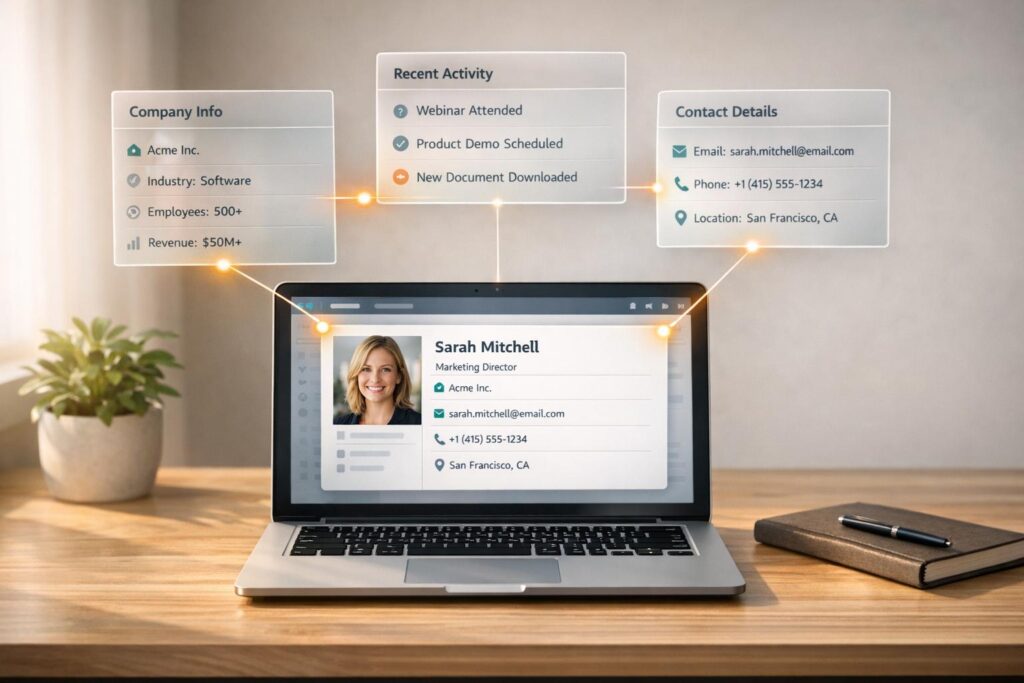
Event-triggered data enrichment uses AI to update CRM records instantly when specific events – like job changes or funding news – occur. This automation solves common problems like outdated data, manual errors, and missed opportunities. Key benefits include:
- Real-time updates: AI monitors signals like LinkedIn changes, funding announcements, and website visits.
- Improved data accuracy: AI validates data from multiple sources, reducing errors and outdated information.
- Time savings: Sales teams save 8–12 hours weekly by eliminating manual data entry.
- Higher lead conversion: Companies see up to a 29% increase in B2B sales and 44% more sales-qualified leads.
AI tools like CRM Copilot.AI automate workflows, ensuring sales teams act quickly on high-value opportunities. By maintaining continuously enriched data, businesses avoid the pitfalls of data decay and improve sales outcomes.
Automate CRM Enrichment For Demo Requests (AI workflow)
sbb-itb-0ae5139
Common Problems with Event-Triggered Data Enrichment
Outdated or manual event-triggered enrichment systems can create serious delays. The lag between an event happening and it being reflected in your CRM can mean losing out on key opportunities. These delays show up in several ways that can hurt lead conversion.
Slow Lead Updates
Even though leads may come in real time, enrichment often happens in batches – or only when someone remembers. This mismatch in timing can cause missed chances to respond quickly. Manual research adds further delays, making it harder to capitalize on "speed-to-lead" moments[6].
Wrong or Missing Contact Data
Many mid-market CRMs have a big problem: around 40% or more of their records often lack essential firmographic details like industry or revenue[9]. While top B2B data providers aim for accuracy rates of 70% to 85%, some individual providers hit only 50% to 70%[9]. This leads to issues like sales reps calling disconnected numbers or emailing people who’ve left their roles. These errors not only waste time but also damage trust in your system. Plus, a hard bounce rate above 2% can even get your domain blacklisted[7].
"Poor data quality costs organizations at least $12.9 million per year on average." – Gartner[6]
Conflicting data from vendors – such as one source listing 500 employees while another lists 1,200 – can waste valuable time. Errors like inaccurate employee counts can misroute high-value leads, hurting efficiency and the customer experience[6][9].
Human Error in Manual CRM Updates
Sales reps spend about 27% of their time on tasks like searching for contact details and verifying records[7]. That’s more than one full day each week that could be used for selling. Manual research doesn’t scale well as lead volume grows, causing backlogs[5]. During calls, reps often capture only a small portion of useful insights[4]. As a result, 71% of sales reps say they spend too much time on data entry, leaving them with just 35% of their time for selling[10]. These inefficiencies can cost companies about $8,400 per rep each month in lost productivity. Worse, only 23% of sales reps trust their CRM data enough to rely on it for outreach[8].
Failing to Act on Real-Time Events
Event triggers like job changes or funding announcements are high-intent signals but have a short window of relevance. If a key decision-maker joins a company, the first vendor to respond with tailored insights gains a big advantage. But if your team depends on weekly updates or manual checks, you’re likely too late to make an impact. Delays in verification can cause you to miss these fleeting opportunities[6].
These issues affect various types of data, as shown below.
| Enrichment Type | Key Challenge | Business Impact |
|---|---|---|
| Firmographic | Missing revenue/size data | Broken lead routing and territory assignment |
| Technographic | Outdated software stack info | Weak competitive positioning and outreach |
| Contact | Job changes and bounces | Failed outreach and sender reputation issues |
| Intent | High volatility/short shelf-life | Missed chances to act on timely signals |
The next sections will explore how AI can address these problems by turning them into actionable, real-time insights.
How AI Identifies and Acts on Event Triggers
AI systems are always on the lookout, scanning both external and internal data sources to spot meaningful changes. These systems monitor platforms like LinkedIn profiles, business registries, news feeds, and even internal communication tools such as Google Workspace emails, Microsoft 365 calendars, Slack messages, and Zoom call transcripts. For example, AI can instantly flag events like a decision-maker switching jobs, a company announcing new funding, or a prospect frequently visiting your pricing page. This real-time detection paves the way for a closer look at how AI uses data validation and alert mechanisms to turn these signals into actionable insights.
But AI doesn’t just gather data – it interprets it. By analyzing intent signals, such as visits to demo request forms, integration documentation, or pricing pages, AI determines which events are most relevant for your sales team. It also evaluates firmographic and technographic changes, like updates to a company’s tech stack or signs of growth, uncovering opportunities that manual research could easily miss.
Tracking Intent Signals and Event Data
AI excels at tracking behavioral patterns across various touchpoints to gauge buyer intent. For instance, if a prospect repeatedly visits a pricing page or downloads technical documents, these actions are flagged as high-intent signals. Once detected, the system immediately enriches the data and sends alerts, ensuring your team doesn’t miss a beat. This proactive approach eliminates the delays often associated with traditional, batch-based data processing.
What’s more, AI dives into unstructured data sources that are typically overlooked. For example, call transcripts might reveal mentions of budget approvals or changes in a company’s hierarchy, while email threads could highlight an internal advocate pushing for your solution. By turning these interactions into structured insights, AI uncovers valuable data points that conventional methods might miss entirely.
Using Predictive Analytics for Event Triggers
Predictive analytics takes things a step further by using historical win/loss data to forecast which triggers require immediate action. These models assign confidence scores to validate triggers and minimize false positives. They also predict when CRM records are likely to go stale by analyzing factors like company volatility and industry trends. Given that B2B databases typically decay at a rate of 22% to 30% per year[7], predictive systems can flag outdated records for re-enrichment before they disrupt outreach efforts.
For example, when a "champion" at a client company moves to a new organization, AI detects the change within 24 to 48 hours. It then automatically creates a new lead record and alerts your customer success team to potential churn risks[11]. This ensures your CRM stays up-to-date and your team can act quickly on emerging opportunities.
Automatic Event Detection and Alerts
Once AI identifies a trigger, it springs into action. The system processes the event data, normalizes it, validates it across multiple sources through waterfall enrichment, and updates your CRM in real time. This seamless workflow means sales teams receive instant alerts – via Slack or Microsoft Teams – complete with context about why the lead is important right now[2].
For instance, if AI detects a job change, the notification might include the contact’s new company, their previous engagement with your product, and even a suggested outreach message – all delivered within minutes. Timing is critical here: outreach triggered by a champion’s job change often achieves reply rates between 15% and 25%[11].
"An email sent at the right moment converts 10x better than a perfectly written email sent at the wrong time."[11]
- Kushal Magar, SyncGTM
AI-Driven Workflows for Real-Time Data Enrichment
When AI detects a trigger event, it kicks off a series of automated workflows designed to transform raw signals into verified CRM updates. These workflows operate in milliseconds, ensuring your sales team always has access to the most up-to-date and accurate information. The process involves three key steps: collecting data from various sources, verifying its accuracy, and instantly updating your CRM – all without any manual input.
Event Detection and Data Collection
The moment a prospect enters your system – whether through a form submission, demo request, or even an email – AI springs into action. Point-of-capture triggers ensure enrichment begins immediately, bypassing the sluggish delays of traditional batch processing, where leads could sit idle for hours or even days [2].
AI uses waterfall enrichment to query multiple data providers sequentially, building a comprehensive profile in real time. This method achieves success rates of 85% to 95%, far outperforming the 40% to 70% range typical of single-source tools [2]. Beyond structured data, AI also dives into unstructured sources like email threads, calendar invites, and meeting transcripts to extract and enrich contact details for your CRM [10].
Once the data is collected, AI moves straight into validation to confirm its accuracy.
Real-Time Data Verification
Every enriched field is cross-checked against multiple external sources, such as LinkedIn profiles, company websites, and business registries, to resolve discrepancies and select the most reliable information [6]. AI assigns confidence scores to each data point, automatically updating high-confidence fields in your CRM while flagging uncertain ones for manual review.
This verification happens in real time, often in seconds. For example, email addresses are validated on the spot before outreach, ensuring invalid contacts are removed, which helps protect your sender reputation [12]. While bulk-imported data can hit a staleness rate of 23% within six months, AI-driven continuous enrichment keeps that rate as low as 4% [4]. A notable example is Remote.com, which used automated workflows in July 2025 to enrich over 100,000 accounts every 45 days, achieving a 98.9% data accuracy rate and cutting SDR research time by 40% [12].
With verified data ready, the next step is seamlessly integrating it into your CRM.
Automatic CRM Updates
Once verified, AI writes the enriched data directly into your CRM, triggering additional workflows automatically [6]. This includes lead-to-account matching, deduplication, and routing based on real-time firmographic updates. Sales reps are instantly notified via tools like Slack or Microsoft Teams, complete with relevant context for immediate action.
This automation transforms CRM management from a repetitive chore into a fully streamlined process. Instead of merely suggesting updates for manual implementation, AI handles everything – from data collection and verification to CRM updates and task creation. This real-time approach eliminates delays from manual data entry, addressing common lead management challenges. Sales reps, who typically spend 71% of their time on administrative tasks [10], can save 8 to 12 hours per week. Additionally, poor data quality – which costs businesses an average of $12.9 million annually – can be significantly reduced. AI-driven enrichment has also been shown to increase Sales Qualified Lead conversion rates by 20% to 29% [12]. By maintaining a continuous enrichment layer, AI prevents "CRM drift", the natural decay of data as personnel change roles or companies rebrand [6].
"Lead enrichment is not a ‘project.’ It’s an operational layer that needs to run continuously – like demand capture itself." [6]
- Ameya Deshmukh, VP of Marketing
CRM Copilot.AI: Event Intelligence and Automation Features
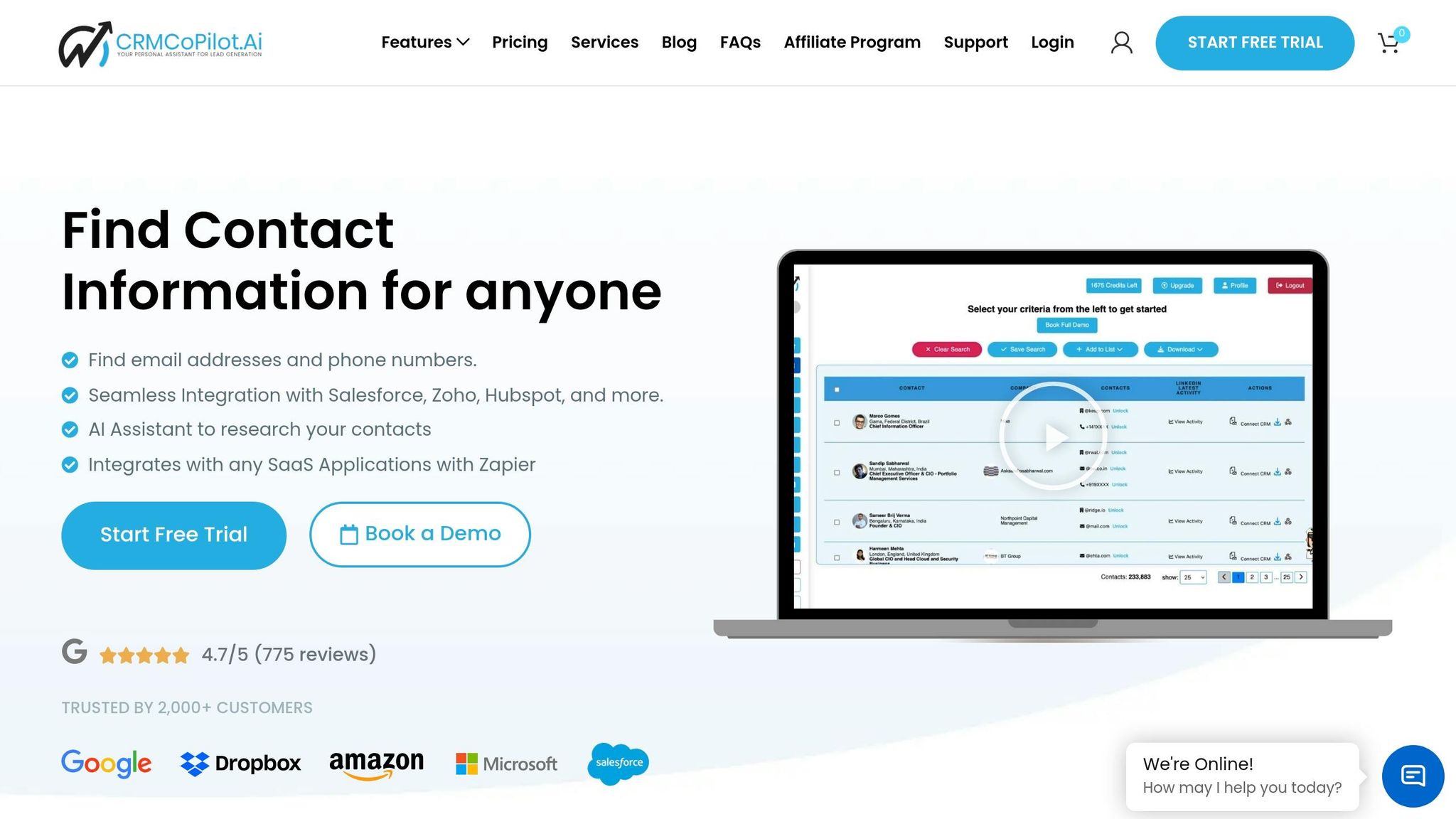
CRM Copilot.AI takes automated event detection to the next level by combining advanced event intelligence with real-time automation, offering a seamless flow of enriched data and streamlined processes.
CRM Copilot.AI eliminates the need for manual updates or periodic bulk refreshes by continuously monitoring CRM data. It triggers enrichment workflows instantly when critical information changes – whether it’s a lead status update, a deal moving forward, or a contact’s job change [13].
Event Intelligence for Lead Management
The platform excels at identifying key buying signals in real time. These include job transitions, funding events, technology adoption, and expansion announcements [1]. For example, if a former customer or decision-maker joins a new company, CRM Copilot.AI initiates re-engagement workflows immediately upon detecting the change [7].
What sets this platform apart is its ability to go beyond standard CRM data. AI agents scan tools like Google Workspace and Microsoft 365, analyzing emails and calendars to uncover new contacts. They enrich records with updated job titles, funding details, and LinkedIn profiles [3][2]. By extracting subtle insights from unstructured data, CRM Copilot.AI provides a depth of information that traditional tools often overlook.
Real-Time Verification and Automated Workflows
Every new data point is scored and verified before being added to your CRM [6]. High-confidence data updates automatically, while less reliable information is flagged for human review. This ensures your team works with dependable insights. The platform also integrates smoothly with other systems, maintaining data accuracy across the board.
Additionally, CRM Copilot.AI automates routine tasks like logging emails, calls, and meetings. This eliminates manual data entry, which typically consumes 27% of a sales rep’s time. For a 10-person sales team, this automation can save over $189,000 annually in labor costs [7]. Verified data is seamlessly incorporated into lead scoring and routing, ensuring qualified leads move efficiently through the pipeline [2]. With these processes in place, teams can focus on outreach and selling rather than administrative upkeep.
Multi-Channel Engagement and Team Efficiency
Thanks to real-time updates and automated workflows, CRM Copilot.AI supports highly personalized outreach across platforms like WhatsApp, email, and LinkedIn. Messages are tailored to each contact’s role and current context [7]. For instance, the Gold plan, priced at $95/month, includes LinkedIn Smart Crawl and Sales Navigator automation, as well as 3,600 email credits and 240 phone credits annually.
Event intelligence also powers instant, context-aware follow-up emails and re-engagement sequences, saving sales teams an average of 6 hours per week [3]. By reducing manual research time by up to 75%, the platform addresses the challenges of delayed updates and human errors, enabling your team to focus on what they do best – closing deals.
Measuring the Impact of AI-Powered Event-Triggered Enrichment
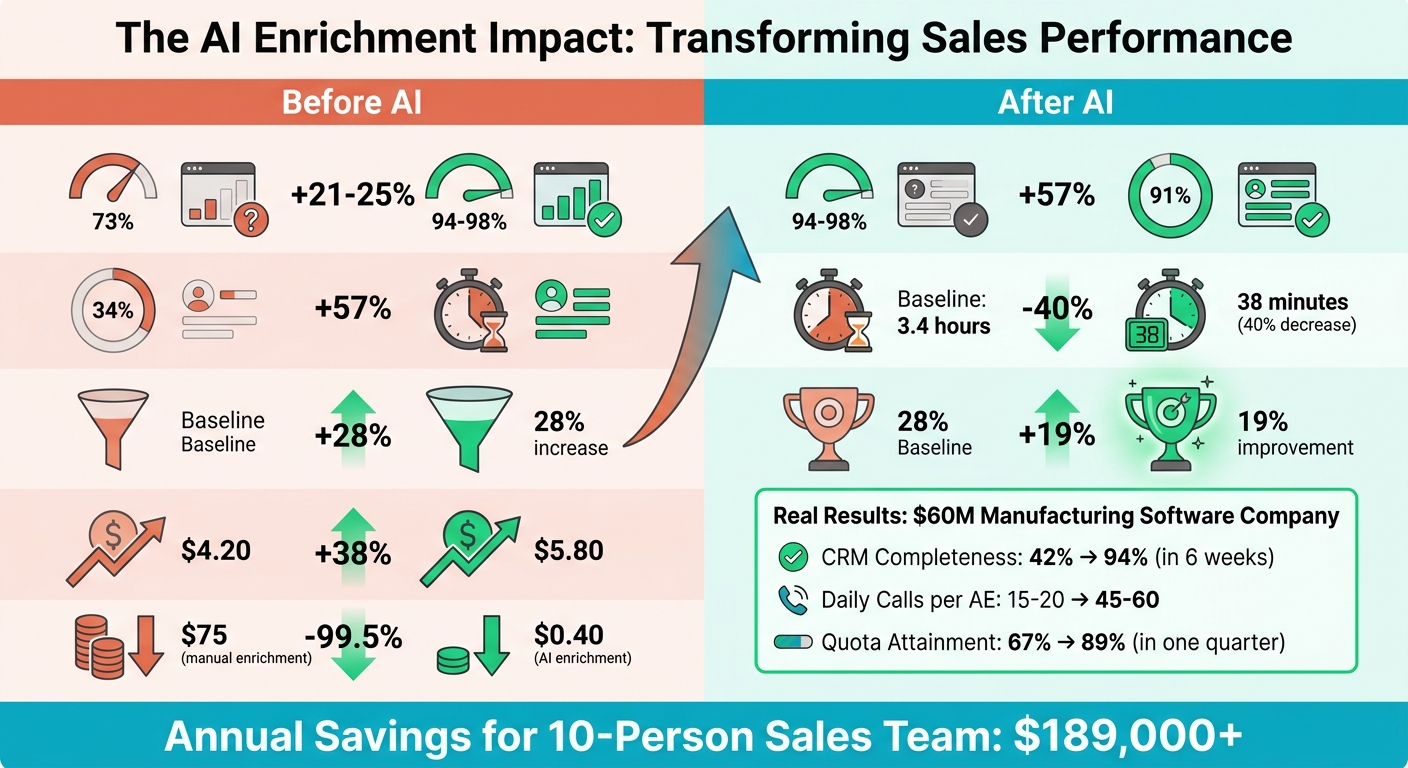
Before vs After AI-Powered Data Enrichment: Key Performance Metrics
AI-driven enrichment significantly enhances data accuracy – jumping from 67% to as high as 96% – and slashes speed-to-lead from 3.4 hours to just 38 minutes. These improvements directly drive pipeline growth and revenue[14][15]. The secret lies in AI’s ability to detect changes in real time and automate workflows seamlessly. Let’s explore how these advancements translate into measurable results and ROI for teams using CRM Copilot.AI.
Before and After AI Implementation
Here’s a real-world example: a $60M manufacturing software company using Salesforce saw CRM completeness skyrocket from 42% to 94% in just six weeks. Thanks to AI, their eight account executives increased daily calls from 15–20 to 45–60. As a result, quota attainment rose from 67% to 89% within a single quarter[8].
| Metric | Before AI (Manual/Bulk) | After AI Implementation |
|---|---|---|
| Data Accuracy | 73%[5] | 94–98%[8] |
| Enrichment Completeness | 34%[5] | 91%[5] |
| Lead Response Time | Baseline | 40% Decrease[5] |
| Lead-to-Opportunity Conversion | Baseline | 28% Increase[5] |
| Win Rate | Baseline | 19% Improvement[5] |
| Revenue per Lead | $4.20[5] | $5.80[5] |
The financial benefits go well beyond improved conversion rates. Consider the costs of manual enrichment: roughly $75 per lead due to labor and processing time. AI reduces this to just $0.40 per lead[5]. For a 10-person sales team, eliminating manual data tasks could save over $189,000 annually in labor costs[7].
ROI Analysis for CRM Copilot.AI Plans
The ROI of AI-driven workflows becomes even clearer when you look at operational and financial returns. CRM Copilot.AI’s pricing plans are structured to maximize value for sales teams.
- Gold Plan ($95/month): Includes 3,600 email credits and 240 phone credits annually, plus LinkedIn Smart Crawl and Sales Navigator automation. For a mid-sized team processing 300 leads weekly, the automation provided by this plan can reclaim up to 27% of the team’s working hours previously spent on manual data tasks[7].
- Platinum Plan ($250/month): Offers 7,200 email credits and 480 phone credits per year, along with advanced AI workflows and full automation. This tier ensures faster response times, better data accuracy, and increased sales productivity. Sales reps can focus on closing deals instead of data entry[7].
"I used to be a data entry clerk who happened to sit in the sales org. Now I’m an analyst. I review the AI’s enrichment, flag the leads with the most interesting patterns, and brief the AEs on what the data is telling us."
Conclusion
Event-triggered data enrichment has evolved from being a manual, sporadic process to a continuous, AI-powered operation. And the stakes are high: outdated lead data, missing contact details, human errors, and missed real-time opportunities cost businesses an average of $12.9 million annually[6]. AI steps in to solve these issues by detecting events automatically, pulling insights from unstructured sources like call transcripts, and keeping CRMs updated in real time.
The results speak for themselves. Companies using AI-driven enrichment report data accuracy rates as high as 98%, a 40% reduction in lead response times, and a 19% boost in win rates[5]. One example? A $60M manufacturing software company improved CRM completeness from 42% to 94% in just six weeks, with quota attainment climbing from 67% to 89%[8].
CRM Copilot.AI plays a key role in delivering these outcomes. Its event intelligence, real-time verification, and automated workflows make it a game-changer. The Gold Plan ($95/month) helps teams reclaim up to 27% of their time previously spent on manual data entry, while the Platinum Plan ($250/month, billed annually) offers full automation, including 7,200 email credits and 480 phone credits each year. At just $0.40 per lead – compared to around $75 for manual enrichment – the return on investment is both immediate and striking[5].
With B2B data decaying at a rate of 22–30% annually[7], traditional batch enrichment methods simply can’t keep up. AI-powered, event-triggered enrichment ensures your team always has accurate, up-to-date information to engage prospects at the perfect time. Instead of treating data as a maintenance headache, this approach transforms it into a strategic advantage that fuels pipeline growth and drives revenue.
FAQs
Which events should trigger enrichment in my CRM?
When a new prospect enters your CRM – like after a form submission or lead creation/update – this should automatically trigger data enrichment. These triggers allow you to enhance contact and firmographic details right away, ensuring your team can act quickly. Beyond that, actions like post-meeting updates, follow-ups, and periodic data refreshes help prevent outdated information. This keeps your CRM accurate and supports more effective lead management and sales efforts.
How does AI verify conflicting data sources automatically?
AI cross-checks conflicting data by examining and comparing information from various sources. It spots inconsistencies and works to resolve them, ensuring the data remains accurate and consistent. This approach improves reliability and keeps records current, supporting more informed decision-making.
How do I measure ROI from event-triggered enrichment?
Measuring ROI from event-triggered enrichment involves keeping an eye on key metrics such as lead quality, response rates, and conversion improvements. A good approach is to compare engagement and sales results for enriched leads with data from periods when enrichment wasn’t applied. Many businesses have seen notable ROI boosts and quicker lead qualification by leveraging AI-powered tools like CRM Copilot.AI. Additionally, tracking speed-to-lead response times can reveal efficiency improvements that directly contribute to ROI growth.