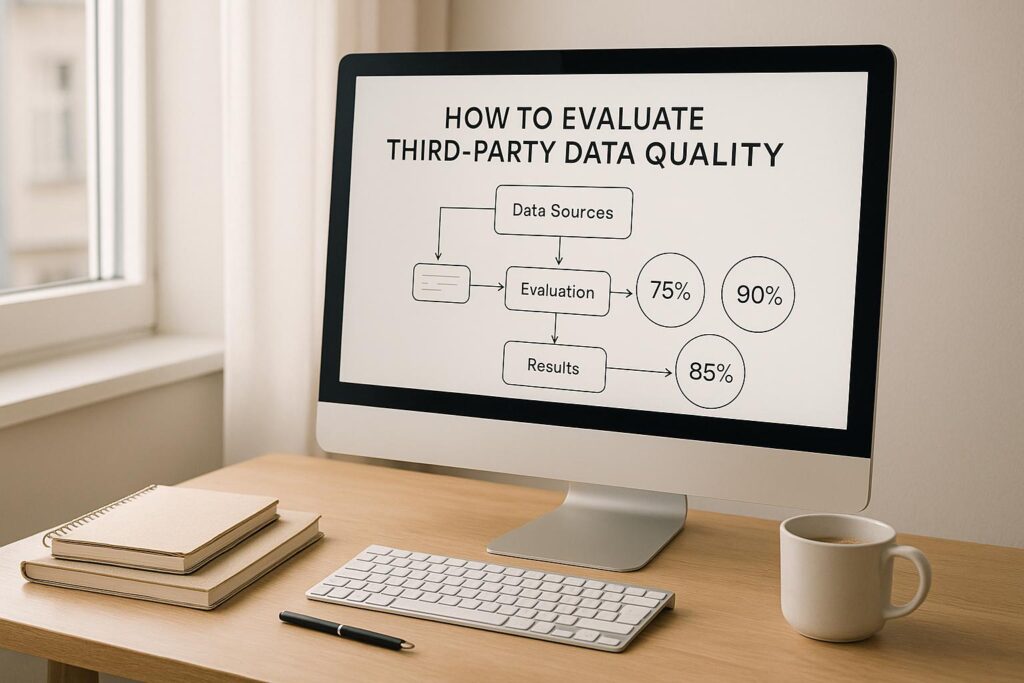
Bad data wastes time and money. Accurate, reliable third-party data is critical for effective CRM and lead generation. Here’s how to evaluate and maintain data quality:
- Key Dimensions of Data Quality:
- Accuracy: Ensure contact details like emails and phone numbers are correct to avoid wasted outreach efforts.
- Completeness: Verify that all essential fields (e.g., job titles, company info) are filled for better segmentation and targeting.
- Consistency: Standardize data formats to prevent duplicates and confusion across systems.
- Timeliness: Keep information updated to avoid using stale data as contacts and companies change.
- Reliability: Partner with providers that are transparent about their data collection and verification processes.
- Steps to Assess Data Quality:
- Data Profiling: Analyze and flag inconsistencies or missing fields using tools and benchmarks aligned with your Ideal Customer Profile (ICP).
- Validation: Cross-check data against your business rules, ensuring it meets your specific needs.
- Regular Monitoring: Continuously review and update data to maintain quality over time.
- Choosing a Provider:
- Look for transparency in data sources and compliance with privacy laws like CCPA.
- Evaluate their accuracy guarantees, update frequency, and CRM integration capabilities.
- Use sample data to test their claims.
- Leverage AI Tools:
- Automate real-time verification of emails, phone numbers, and other contact details.
- Use customizable filters to find leads aligned with your ICP.
- Ensure seamless integration with CRM platforms like Salesforce or HubSpot.
Bottom Line: High-quality third-party data improves efficiency, saves resources, and boosts conversions. By focusing on accuracy, completeness, and reliability while leveraging AI tools, you can ensure your CRM supports better business outcomes.
6 Tips & Tools to Improve Data Quality in Salesforce
Key Dimensions of Data Quality
To truly harness the power of your CRM and boost lead generation, you need to understand the five key dimensions of data quality. These dimensions are the backbone of actionable, efficient insights and can be the difference between achieving results or running into obstacles. Each plays a critical role in determining whether your third-party data will help you succeed or slow you down.
Let’s start with the most fundamental aspect: accuracy.
Accuracy
Accuracy is all about having correct and reliable contact details. When your data is accurate, your sales team can focus on connecting with real prospects. But when it’s not, your entire workflow can be thrown off.
Email accuracy stands out as especially critical since email is often the first touchpoint with a prospect. Invalid email addresses don’t just waste time – they can hurt your sender reputation and reduce email deliverability rates. Similarly, having accurate phone numbers is essential for strategies that rely on direct outreach.
"Our AI-powered system ensures accurate, up-to-date contact data, so you always connect with the right people." [1]
Without accurate data, your team spends more time verifying information than engaging with leads. Real-time verification tools can help eliminate this issue and keep your process running smoothly.
Completeness
Complete data ensures you have all the essential information needed to effectively engage with prospects. Missing details – like phone numbers, job titles, or company information – can slow down your sales process and hinder your ability to connect meaningfully.
When your data includes verified email addresses, direct phone numbers, and comprehensive company profiles (including demographic and firmographic details), your sales team can approach each prospect with confidence. This level of detail also allows for precise segmentation and tailored outreach strategies.
On the other hand, incomplete data forces your team to spend valuable time filling in the gaps instead of building relationships. This inefficiency reduces the number of prospects you can effectively manage and engage.
Consistency
Consistency in data formatting is crucial for avoiding confusion and ensuring seamless integration across your tools and systems. Variations in how contact details or company names are recorded can lead to duplicate records and fragmented customer profiles.
Standardizing formats – such as phone numbers, addresses, and company names – helps keep your CRM clean and organized. Ensuring consistency at the field level (e.g., job titles, industries, company sizes) also simplifies reporting, improves the accuracy of targeted campaigns, and makes it easier to track performance across different segments.
Timeliness
In a fast-paced sales environment, outdated information can quickly derail opportunities. Contact details change constantly as people switch jobs and companies evolve. Relying on stale data wastes time and effort.
With contact data degrading at an estimated rate of 2% per month, keeping your data fresh is a must [1]. Real-time updates are essential – they continuously monitor and refresh contact details to reflect changes as they happen, helping your team stay on top of current opportunities.
Reliability
Reliability comes down to trusting your data sources to consistently deliver accurate and stable information. This means partnering with providers who are transparent about their data collection and verification methods.
Source transparency is key. Providers that clearly explain their processes tend to deliver more dependable results, ensuring you can rely on their data to support your lead generation efforts.
"Accuracy, efficiency, and results – that’s the CRMCoPilot way." [1]
Reliable data ensures steady quality over time, even when market conditions or volume demands fluctuate. This consistency makes it easier to maintain predictable and efficient lead generation processes.
With these dimensions in mind, the next step is to explore how to evaluate and apply them in your workflows.
Step-by-Step Process for Assessing Third-Party Data Quality
Now that you’re familiar with the key aspects of data quality, it’s time to put that understanding into practice. Taking a structured approach to evaluate third-party data can help you make smarter decisions and steer clear of expensive errors. Here’s a breakdown of three steps to ensure your data aligns with business expectations.
Data Profiling and Analysis
Think of data profiling as your first checkpoint for spotting potential quality issues. This step involves analyzing the structure, content, and patterns in your third-party data to detect any red flags.
Start by defining your Ideal Customer Profile (ICP) and setting clear quality benchmarks. Use tailored search filters to focus on criteria like location, industry, or company size – this way, you’re not just collecting data but sourcing leads that genuinely fit your business needs.
Next, dig into the details to uncover patterns or inconsistencies. Watch for irregularities like formatting discrepancies, missing values, or unusual entries. For example, email addresses with strange domain names or phone numbers that don’t match regional formats might indicate low-quality data.
Leverage AI tools to verify contact details – such as email addresses – right from the start. This ensures that your data is accurate and up-to-date, saving you from chasing invalid leads. Organize your findings into segments that align with your sales strategies, giving you more control over lead generation.
Validation Against Business Rules
After profiling, it’s time to validate the data against your specific business requirements. This step ensures the data isn’t just technically sound but also fits your organization’s unique needs.
Create rule-based frameworks tailored to your business goals. These rules could include mandatory fields, acceptable value ranges, or critical details like verified phone numbers for prospects requiring direct contact. For instance, if your sales strategy relies heavily on phone outreach, records missing valid phone numbers should be flagged immediately.
AI tools can help you refine your prospect list to match your ICP, going beyond basic checks to ensure each lead is relevant and ready for engagement. Integration with platforms like Salesforce, Zoho, or HubSpot can streamline this process, automatically syncing validated records and flagging any that fall short of your standards.
Regular Monitoring and Reviews
Maintaining data quality isn’t a one-and-done task – it’s an ongoing effort. Regular monitoring and reviews are essential to catching issues early and keeping your lead generation on track.
Keep an eye on data quality metrics continuously. AI-powered tools can provide real-time verification, ensuring your contact information stays accurate as market conditions shift. Schedule periodic reviews – monthly or quarterly, depending on your data volume – to spot trends, address recurring issues, and assess the performance of your third-party data providers.
Use these insights to fine-tune your quality benchmarks and validation rules. Reusing your search criteria can help maintain consistency, while tracking quality metrics allows you to measure the impact of quality improvements on sales performance. It also provides a solid case for investing further in data quality enhancements.
With over 2,000 businesses relying on CRMCoPilot’s data quality solutions and an impressive 4.7/5 rating based on 775 reviews [1], companies are seeing tangible benefits from systematic data management. As one satisfied user shared:
"Saved hours on data entry with CRMCoPilot. The customization options are fantastic, and the tool is compatible with my CRM. Highly recommended for busy professionals."
– Harleigh Dodson
sbb-itb-0ae5139
Evaluating Third-Party Providers: Key Criteria
Choosing the right data provider can make or break your lead generation efforts. To ensure success, it’s crucial to evaluate their practices, reliability, and how well they align with your business needs. Here are the key factors to keep in mind when making your decision.
Transparency in Data Sources
A reliable data provider should clearly explain how they collect, verify, and maintain their data. This level of transparency ensures you know exactly what you’re paying for and how it fits your business goals.
Ask for detailed documentation about their data collection methods. Providers often use techniques like web scraping, public records, partnerships, or user-submitted information. Understanding these methods helps you determine if the data aligns with your target audience and quality expectations.
Providers that verify contact details in real time show a strong commitment to accuracy. Additionally, inquire about how they handle data updates and maintenance. Request sample data sets to test their claims about accuracy and relevance. This hands-on approach can help you gauge whether their data meets your standards. Also, take into account how they address data privacy regulations.
Compliance with Regulations
With data privacy laws in the U.S. becoming stricter, compliance is a must when choosing a third-party provider. Adhering to these regulations protects both your business and your prospects.
Ensure the provider complies with laws like the California Consumer Privacy Act (CCPA). Even if your company isn’t based in California, many of your prospects might be, making this compliance essential.
You should also consider any industry-specific regulations that apply to your business. For example, healthcare businesses need HIPAA compliance, financial services must follow the Gramm-Leach-Bliley Act, and companies handling children’s data are bound by COPPA guidelines.
Ask about their policies for data retention and deletion. Providers should have clear procedures for removing data upon request and only keeping records as long as necessary. This responsible approach reduces liability risks. Additionally, providers should offer opt-out options and respect do-not-contact preferences, which not only ensures legal compliance but also protects your brand’s reputation. Once compliance is confirmed, turn your focus to their performance metrics and service-level agreements (SLAs).
Performance Metrics and SLAs
SLAs and performance metrics offer measurable benchmarks to evaluate a provider’s reliability and hold them accountable for their promises. These metrics should align with your business goals and provide tangible ways to assess value.
Start by focusing on data accuracy and verification rates. Providers should clearly outline their accuracy guarantees and the mechanisms they use to maintain high-quality data.
Check how frequently they update their data. Providers committed to keeping information current demonstrate reliability and compliance. Ask about their update timelines and how quickly changes are reflected in your data feeds.
Also, evaluate lead conversion and effectiveness. The best providers deliver accurate, AI-verified contact data that translates into real business results.
Take CRM Copilot.AI as an example. With a 4.7/5 rating based on 775 reviews and recognition as the "#1 Highest Rated Lead Intelligence Software by G2" [1], this platform is trusted by over 2,000 businesses. It consistently delivers accurate, up-to-date contact data that helps drive results.
Lastly, consider integration capabilities. Your provider should easily connect with popular CRM systems like Salesforce, Zoho, and HubSpot, while also offering flexible export options like CSV and Excel. Seamless integration with your CRM ensures smoother operations and greater efficiency.
Using AI-Driven Tools for Data Quality in CRM
Manually verifying data can be a tedious and error-prone task, especially when dealing with large volumes of third-party information. AI-driven tools are reshaping how businesses ensure data quality in their CRM systems by automating verification processes around the clock. These tools help maintain data integrity while reducing the time and effort required. Here’s how AI-powered solutions simplify and enhance these processes.
Real-Time Data Verification
With a focus on accuracy and speed, CRM Copilot.AI uses artificial intelligence to verify contact details the moment they are entered into your CRM. This real-time verification helps prevent issues like bounced emails or invalid phone numbers. It also ensures that leads are sourced and validated based on your specific criteria. As one user, Mike S, shared:
"CRMCoPilot delivered exactly what I needed – simplicity and results. The AI-powered search is spot-on, and the export feature to Google Sheets is a lifesaver. Loving it!"
Customizable Search Filters
The tool also offers highly customizable search filters, enabling you to find leads that align with your ideal customer profile. Whether you’re targeting by location (down to individual U.S. states), industry, company size, or other factors, these filters make it easy to refine your search. Plus, you can save your settings for recurring searches, saving time and ensuring consistency.
CRM Integration
Smooth integration with your existing CRM system is essential for avoiding data silos and keeping your information reliable. CRM Copilot.AI connects seamlessly with major platforms like Salesforce, Zoho, and HubSpot, automatically syncing verified leads into your workflows. For added flexibility, it also integrates with specialized SaaS tools through Zapier. This ensures your data remains consistent and accessible across all systems. Kingsley Chandler highlighted the benefits, saying:
"CRMCoPilot made lead generation a breeze! The automation is seamless, and I’ve seen a significant boost in my efficiency. Closing deals has never been smoother."
With over 2,000 customers and a 4.7/5 rating from 775 reviews, CRM Copilot.AI has earned recognition as the "#1 Highest Rated Lead Intelligence Software by G2" [1].
Conclusion: Ensuring Data Quality for Better Business Outcomes
The success of CRM and lead generation efforts hinges on having reliable, high-quality third-party data. When your sales team has access to accurate information, they can spend more time building meaningful relationships and closing deals. On the flip side, poor-quality data wastes time, leads to missed opportunities, and frustrates prospects with irrelevant outreach.
To maintain data integrity, it’s crucial to adopt a structured process for assessing third-party data. This includes steps like profiling, validation, and ongoing monitoring. As your database expands, manual checks become impractical, making AI-powered automation a game-changer. By streamlining data management, businesses can achieve stronger CRM performance and drive growth.
FAQs
How can businesses confirm their third-party data provider complies with privacy laws like CCPA?
To align with privacy laws like the California Consumer Privacy Act (CCPA), businesses need to take a close look at their third-party data providers. Start by ensuring the provider has clear privacy policies, respects consumer rights, and uses robust data security practices. It’s crucial to choose providers who are upfront about how they collect and process data, allow consumers to opt out of data sharing, and prioritize protecting sensitive information.
Ask for documented proof of compliance – certifications or audit reports can provide peace of mind. Including privacy compliance clauses in contracts is another smart move. To stay on top of things, schedule regular audits to confirm the provider continues to meet legal requirements.
What are the advantages of using AI for real-time data verification in CRM systems?
AI-powered tools for real-time data verification bring a host of benefits to CRM systems. They keep contact information accurate and current, which cuts down on errors and improves the effectiveness of outreach efforts. By automating the data validation process, these tools save time and allow teams to focus on more strategic tasks.
On top of that, AI strengthens the reliability of your data, paving the way for better decisions and higher-quality leads. This not only enhances sales efficiency but also drives up conversion rates, enabling teams to work more effectively and hit their targets faster.
How often should businesses review data quality to ensure accurate and reliable CRM systems?
To keep your CRM system running like a well-oiled machine, it’s essential to check the quality of your data at least once every three months. These regular reviews help pinpoint outdated, incomplete, or incorrect entries, ensuring your CRM stays reliable for making decisions and engaging with customers effectively.
If you’re in a fast-paced industry like sales or marketing, where data changes quickly, you might need to review your CRM even more often to stay on top of trends and customer updates. Setting up a consistent schedule for these checks can make a big difference in how efficiently your CRM works for your business.